New Sensors for Drug Monitoring
Novel bioluminescent protein sensors monitor drug concentrations in patients’ samples in a fast, cheap, and precise manner
http://www.chemistryviews.org/details/news/6287211/New_Sensors_for_Drug_Monitoring.html


Novel bioluminescent protein sensors monitor drug concentrations in patients’ samples in a fast, cheap, and precise manner
http://www.chemistryviews.org/details/news/6287211/New_Sensors_for_Drug_Monitoring.html

Nanomechanical detection of methamphetamines and designer drugs
http://www.chemistryviews.org/details/ezine/6286411/Drug_Sensing_by_a_Synthetic_Receptor.html


Perfluorocarbonate nanoparticles delivering melittin as a novel anti-HIV strategy
http://www.chemistryviews.org/details/news/6210811/Nanoparticles_Against_HIV.html
Hepatitis C market by 2018 is expected to grow more than 3 times from its current market size of 2012. Hepatitis C virus (HCV) infection is a complex public health problem, characterized by a high prevalence of chronic infection, an increasing burden of HCV-associated disease, low rates of testing, treatment and the prospect of increasing incidence associated with the epidemic of injection drug use.
Hepatitis C Market Overview
Hepatitis C is a leading cause of chronic liver disease, end-stage cirrhosis and liver cancer. Because of the slow progression and asymptomatic character of the infection, many people are unaware of having it. As a consequence, the infection is often diagnosed at a late stage when treatment options are limited. As no effective vaccine against the Hepatitis C virus (HCV) has been discovered so far the market is driven by therapeutics. The increase in the prevalence of the disease and the availability of new first-in-class therapies with better safety and efficacy profiles are expected to drive the growth of the HCV market. The growth in HCV drugs market is primarily attributed to high unmet need in the market which is expected to be fulfilled by strong pipeline candidates. Low levels of awareness and knowledge about HCV have been identified as a formidable challenge to prevention and care.
Complete report is available @ http://www.rnrmarketresearch.com/hepatitis-c-market-forecast-hcv-drugs-clinical-trials-hepatitis-c-pipeline-drugs-sales-forecast-worldwide-market-report.html .
Renub Research study titled “Hepatitis C Market & Forecast, HCV Drugs Clinical Trials, Hepatitis C Pipeline Drugs Sales & Forecast – Worldwide” provides a comprehensive assessment of the fast-evolving, high-growth of Hepatitis sector. This 164 page report with 25 Figures and 2 Tables studies the Hepatitis C Drug Market Landscape. This report contains 7 chapters.
Hepatitis C – Approved Drugs sales & Forecast Analysis (To 2016) (Chapter No. 3)
Hepatitis C – Pipeline Drugs Clinical Trials (Drugs in Phase III) (Chapter No. 5)
Purchase a copy of this report @ http://www.rnrmarketresearch.com/contacts/purchase?rname=186104 .
Hepatitis C – Pipeline Drugs Clinical Trials (Drugs in Phase II) (Chapter No. 6)
Hepatitis C – Pipeline Drugs Sales Forecast (Chapter 7)

Data Sources
This report is built using data and information sourced from proprietary databases, primary and secondary research and in-house analysis by Renub Research team of industry experts.
Primary sources include industry surveys and telephone interviews with industry experts.
Secondary sources information and data has been collected from various printable and non-printable sources like search engines, News websites, Government Websites, Trade Journals, White papers, Government Agencies, Magazines, Newspapers, Trade associations, Books, Industry Portals, Industry Associations and access to more than 500 paid databases.
For more information:

| AmVac begins Phase III trial of Gynevac vaccine for bacterial vaginosis |
| AmVac has commenced a Phase III study of its Gynevac to assess the safety and efficacy of the vaccine in bacterial vaginosis (BV) treatment. |
AmVac has commenced a Phase III study of its Gynevac to assess the safety and efficacy of the vaccine in bacterial vaginosis (BV) treatment.

Manufactured in accordance with the current GMP standards, the therapeutic vaccine is based on a blend of inactivated lactobacilli strains.


Love, cast in stone: Temples in India depicting erotic art

India is dotted with many glorious temples, but erotica on the walls of some arouses curiosity and even puzzles tourists. There are various theories about the reason for such vivid depiction of erotica–mass sex education, warding off natural calamities and the devdasi system. Due to the presence of 64 Yogini temples near Khajuraho, Padawali, Konarak/Lingaraj etc., scholars also attribute the erotic art to Tantric practices, which revolve around the ultimate union of the male and the female energy and forms referred to as Maithuna. Whatever the reason be, the brazenness or ethereal beauty of temple erotica will never cease to amaze us.
Khajuraho, Madhya Pradesh

Built by the Chandela Kings who were greatly influenced by Tantric traditions, this temple is said to represent the ultimate seductress.
While the fine sandstone statues built earlier have a well rounded finish, the ones made later are more angular. In his history of the Kamasutra, Mc Connachie describes the amorous sculptures as “the apogee of erotic art”, where the twisting, broad hipped and high breasted nymphs, fleshy apsaras and extravagantly interlocked maithunas run riot along the surface of stone.
The various scenes of passionate love making, in acrobatic postures that sometimes border on the physically impossible, strike viewers. Look out for the bold panels of multiple partners engaged with each other. For an interesting perspective on Khajuraho, watch the Sound and Light show. The best time to visit is during the Khajuraho Dance Festival in the first week of February.
Markandeshwar Temple, Maharashtra

Near the naxal district of Gadchiroli, the Markandeshwar temple complex, by the River Wainganga, showcases a sprinkling of erotic art. A couple performing ‘fellacio’ will raise eyebrows. Know to be built by danavas (evil forces) in one night, the temple is made from stone, and follows Hemadpanth architecture. The annual fair during Mahashivratri attracts devotees from far and wide every year. Hiring a car from Nagpur is recommended, unless you fancy hitch-hiking with villagers past moonlit fields or changing several buses and autos. If you’re stranded, look for the dharamshala near the temple.
Padawali Temple, Madhya Pradesh

In Morena district near the Chambal Valley, once notorious for dacoits, lies the fortress of Padawali. Two stalwart lion statues greet you at its entrance. The temple inside has earned the reputation being a ‘Mini Khajuraho’ due to the prevalence of erotic art. The difference between big brother Khajuraho and Padawali Temple, is that the erotic art here seems less acrobatic and more ‘real life’ and ‘doable’. The carvings of maithunas in various positions, ranging from simple to difficult almost brings the Kamasutra to life.
Ranakpur Jain Temples, Rajasthan
This marble temple of superlative beauty is a ‘vision in white’ with its domes, shikharas and turrets. Over 1,444 intricately carved marble pillars hold up the temple and a monolithic marble rock depicting over 100 snakes catches the eye. Look out for a panel depicting several experimental love making scenes, in a line with a central queen-like figure seated on a throne, with an amorous midget on her lap. It’s interesting to note that not only Hindus, but even Jains decorated temples with erotic art. It hints at how nudity had a religious connect due to the ‘Digambara’ ideology or the Tantric cult.
Sun Temple, Orissa

When I first visited the Sun Temple at Konarak in Orissa, as a giggly 16-year-old , I was taken aback by how the panels revealed way more about the ‘birds and bees’ than our biology classes had taught us. My second visit recently, helped me appreciate the beautiful erotic art better. The brazenness of the sculptures here gives Khajuraho stiff competition; one of the most scandalous panels is of a dog licking a woman’s genital area. I overheard a guide say, “this was considered a cure for sex related infections, as the dog’s saliva has antibiotic properties.” Scenes of polygamy, polyandry and lesbian love are blissfully abundant.
An architectural genius, this temple shows the Sun God on a colossal chariot drawn by seven horses. The word Konarak is a combination of Kona (corner) and Arka (Sun). The temple was previously located closer to the sea, but the magnetic properties of its stone caused shipwrecks. This, along with the dark colour of its stones, earned it the tile of ‘The Black Pagoda’. An interesting study in contrast is the famous Jagannath Temple at Puri, also referred to as ‘The White Pagoda’ due to its whitewashed walls. If you are an art enthusiast you must visit the Konarak Archaeological Museum nearby that contains fallen sculptures from the temple.
Sun Temple, Gujarat

It is believed to be the place where Lord Rama conducted a yagna here to purify himself of the sin of killing a Brahmana-Ravana. Like Konarak, its architecture is such that the temple catches the first rays of the rising sun. The most striking feature of the temple is a perfectly designed Kama Kunda (water tank) meant for ablutions and for a reflection of the temple in the water. It has lateral stone steps leading down to the tank, allowing both direct and diagonal descent from all sides. Carvings of men and women in various acts of sex with small midget like creatures are prominent. However, due to erosion the detailing of the stone carvings is blurred in places.
Osian, Rajasthan

Amidst the sand dunes of Thar, Osian has a cluster of Hindu and Jain temples dating back to the 11 century AD. The Sachiya Mata temple dedicated to the resident Goddess has a gorgeous carved archway leading up to the shrine and has some beautiful depiction of erotic love locked couples, complete with details like the bed on which the couples lie.
Virupaksha Temple, Karnataka
On the banks of the Tungabhadra River, this temple with beautiful pillars and towered gateways dedicated to Lord Shiva in his avatar as Virupaksha. It is one of the oldest functioning temples since the 7th century AD. A panel that catches the eyes depicts a nude woman being ‘admired’ by men and women around her. It is best to visit the temple, during the Hampi festival in November. While in the area, also check out the erotic art on the pillars of the Achyutaraya temple.
Several other temples in South India like Belur, Halebidu, Somanathapura and Nugguhalli, the Badami and Banashankari temples of the Chalukya times and the Vijayanagar temples of Bhatkal and Lepakshi also have a profusion of erotic art. The Meenakshi temple of Madurai and Veeraranarayan temple of Gadag have erotic sculptures on their Gopuram. (Information about other temples with erotic art in South India taken from www.kamat.com)
No one has summed up the beauty of erotica on temple walls better than Tagore while he was referring to Konarak, ‘The language of man here is defeated by the language of stone.’
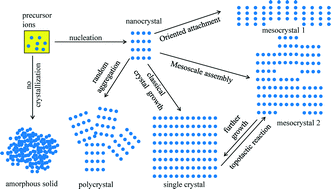
Mesocrystals that consist of crystallographically aligned individual building blocks and controlled level of porosity in between exhibit unique structures and multifunctional behavior. A large number of mesocrystals have been successfully developed by different growth technologies, and various growth mechanisms are discussed. In addition to various self-assembly and growth techniques, considerable attention has been paid to the formation mechanisms where the crystalline colloidal nanoparticles are assembled into mesocrystals via interparticle forces or physical fields. Owing to their high surface area, controllable level of porosity, crystallinity of subunits, oriented subunit alignment, and elegant 3D network structure, the performance of mesocrystals may be superior to their nanocrystalline, single-crystal, and polycrystalline counterparts. There has been a surge in the number of applications demonstrated for mesocrystals over the past couple of years, showing their great application potential.
DOI: 10.1039/C4CE00256C
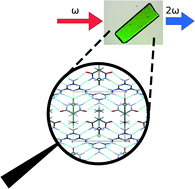
M. Gryl, T. Seidler, K. Stadnicka, I. Matulková, I. Němec, N. Tesařová and P. Němec
CrystEngComm, 2014, 16, 5765 DOI:10.1039/C4CE00178H
The melamine barbital co-crystal is a product of crystal engineering of non-linear optical materials composed of pharmaceutically active ingredients. The resulting crystal phase shows a non-linear effect higher than that of KDP. The material was characterized by means of X-ray diffraction and optical property measurements and calculations.
DOI: 10.1039/C4CE00178H

Fig.1 Production of MAb
Commercially, on large scale, MAbs are produced by two methods.
(a) Ascites production in mice
(b) In-vitro fermentation
The production method is summarized in Fig.no.2a & 2b.

The first monoclonal antibodies approved by FDA for therapeutic use OKTS, is produced by ascitic technology19.
In this method hybridoma cells are injected into peritoneal cavity of histocompatible mice. The mice are pretreated by i.p. injection of Pristane to irritate the peritoneal cavity which facilitates the growth of ascitic tumor. The fluid produced may contain the high concentration of secreted MAbs, 2 to 20 μg / ml and 2 to 6 ml or more can be harvested per mouse. Comparison of different MAb production22,23 methods is shown inTable 1.
1. It is very costly, very difficult and not reliable.
2. Product may get contaminated with mouse immunoglobulins and also with other mouse proteins.
3. Viruses can be introduced as contaminants.
In this method, the cells are grown and gradually moved to larger and larger culture ensuring exponential growth. Typical antibody levels in the culture supernatant ranges from 5-50 μg/ml depending on the individual clone and on cell density. When more production of antibody is required 1-litre cultures in roller bottles are used. Required cells are removed from rest of media by centrifugation or filtration, generally followed by ultra filtration step for concentrating the filtrate by up to 20 folds.
(1) As serum required in culture media is reduced, it is cost effective.
(2) There will not be any contamination with mouse immunoglobulin.
But the major drawback is that of contamination of final product with serum or protein based growth factors.
Table 1: Comparison of different MAb production methods.
|
Production system |
Scale |
Volume (ml) |
Concentration (mg/ml) |
Production time (weeks) |
Quality |
| Ascites (in vivo) |
20-250 mg |
5-10 |
< 20 |
2-3 |
Low |
| Stir growth |
— |
100-2500 |
0.01-0.1 |
2-3 |
High |
| Dialysis membrane |
< 50 mg |
10-25 |
0.1-1.5 |
2-5 |
High |
| Roller bottles |
< 2 gm |
100-2000 |
0.01-0.2 |
2-6 |
High |
| Hollow fiber |
0.15-30 gm |
25-1000 |
0.2-0.3 |
3-12 |
High |
| Fermentor |
2-100 gm |
< 2000 lit |
0.05-0.5 |
2-12 |
High |

Fig. 2a: MAb Production (Flowchart)

Fig. 2b: Freeze Dried MAb Production (Flowchart)
Contamination, during production process, such as protein, nucleic acid, endotoxins, immunoglobulin and adventitious agent can be removed by purification method. The purification methods such as precipitation with ammonium sulphate, zone electrophoresis, ion exchange chromatography, hydrophobic interaction chromatography, gel filtration and affinity chromatography are used19.
· Affinity chromatography is often used for initial purification.
· Ion exchange chromatography is used for removing endotoxins and DNA.
· Gel filtration chromatography can remove both high and low molecular form of monoclonal antibodies and it is usually used as the final polishing step.
The final determination of monoclonality requires biochemical and biophysical characterization of the immunoglobulin. It is also characterized immunochemically to define its affinity for antigen, its immunoglobulin subclass, the epitopes for which it is specific and the effective number of binding site that it possesses19.
Depending upon the intended application, the antibody may be conjugated to specific radionuclide or toxin. Then the stabilizing agent is added, and the product is filled into final container under inert gas or other specialized conditions. Lyophillization is frequently applied to get freeze dried product.
The main problem for mouse MAb is that, human body recognizes it as a foreign agent and produces antibodies against such mouse MAb. The induced human anti-mouse antibodies (HAMA) quickly reduce the effectiveness of mouse MAb and also their interaction may lead to allergic reactions.
To overcome the problem, Human MAbs can be used. Though difficult, this is possible by fusion of EBV (Epstein Barr Virus) transformed human B-lymphocyte with appropriate fusion partners21. EBV is a lymphotrophic DNA herpes virus which is capable of converting normal B-lymphocytes of human and/or mouse into cancer cell having proliferating capacity in vitro. But the presence of EBV as contaminant can pose a problem of producing cancer24.
Even the human-human hybridomas producing MAbs have been produced 25,26. Olsson and Kaplan in the year 1980 produced first human-human myeloma (SKO-007), against the hapten 2, 4-dinitrophenyl (DNP) 19.
The routine production of human MAbs is prevented due to following reason:-
Hence, other alternatives methods come forth.

A new easy way to “clean” pharma ingredients; study
By Natalie Morrison, 28-Jun-2012
Scientists have uncovered a new simple way to “clean” genotoxic impurities (GTIs) in drug ingredients by mixing the solution with contamination-eating scavengers.
http://www.in-pharmatechnologist.com/Ingredients/A-new-easy-way-to-clean-pharma-ingredients-study
http://www.unido.org/fileadmin/user_media/Services/PSD/BEP/APIExploratoryStudy.pdf