AUTHOR OF THIS BLOG

DR ANTHONY MELVIN CRASTO, WORLDDRUGTRACKER

GUEST BLOGGER, Dr Pravin Patil, A New Combination of Cyclohexylhydrazine and IBX for Oxidative Generation of Cyclohexyl Free Radical and Related Synthesis of Parvaquone

 Uncategorized  Comments Off on GUEST BLOGGER, Dr Pravin Patil, A New Combination of Cyclohexylhydrazine and IBX for Oxidative Generation of Cyclohexyl Free Radical and Related Synthesis of Parvaquone
Apr 292017
 

Image for unlabelled figure

As a GUEST BLOGGER, myself Dr Pravin Patil,  presenting my paper as below

A New Combination of Cyclohexylhydrazine and IBX for Oxidative Generation of Cyclohexyl Free Radical and Related Synthesis of Parvaquone

 Pravin C Patil*a and Krishnacharya G Akamanchi

Department of Pharmaceutical Sciences and Technology, Institute of Chemical Technology, Matunga, Mumbai-400 019.

aPresent address: Department of Chemistry, University of Louisville, Louisville, KY, USA.

*Corresponding Author: [email protected]

Tetrahedron Letters 2017, 58 (19), 1883-1886 (Recently published)

[Link: http://www.sciencedirect.com/science/article/pii/S004040391730429X]


Graphical Abstract:

STR0

Abstract: The present paper demonstrate a single-step and straightforward synthesis of parvaquone through intermediacy of cyclohexyl radical generated from novel combination of cyclohexylhydrazine and o-iodoxybenzoic acid and subsequently trapped by 2-hydroxy-1,4-naphthoquinone. Formation of cyclohexyl free radical using this new combination was reaffirmed by cyclohexylation of readily available 2-amino-1, 4-naphthoquinone.

STR0

Scheme: Literature methods for synthesis of parvaquone

STR0

Scheme:  IBX mediated oxidative arylation towards synthesis of 1 (Parvaquone)


STR0

Scheme :  Cyclohexyl radical mediated postulated mechanism for formation of Parvaquone, 1

Synthesis of 2-cyclohexyl-3-hydroxy-1,4-naphthoquinone (parvaquone) (1): To a solution of 3 (1.0 g, 5.74 mmol) in acetonitrile (20 mL) was added IBX (3.80 g, 13.6 mmol) in one lot and stirred for 5 min at room temperature. To this was added dropwise a solution of 8 (0.78 g, 6.8 mmol) dissolved in 10 mL of acetonitrile over the course of 20 min. During the addition of 8 exotherm (up to 35 °C) was observed with evolution of nitrogen gas in the form of bubbles. Reaction progress was monitored by TLC (using mobile phase, hexane: ethyl acetate/5:95). After satisfactory TLC, water (20 mL) was added to the reaction mixture and acetonitrile was evaporated using rotary evaporator. To the residue obtained was added dichloromethane (30 mL). Oganic layer was separated and washed with saturated sodium bicarbonate solution followed by saturated solution of sodium sulphite. Separated organic layer was dried over anhydrous sodium sulphate and evaporated to obtain crude 1 which was further purified by column chromatography (mobile phase – hexane: ethyl acetate/5:95) to afford 1 as yellow solid, (0.88 g, 60% yield); mp 136-138 °C (lit.18 135-136°C); FT-IR (KBr): 3585, 3513, 3071, 2926, 2853, 1666, 1604, 1590 cm-1;

1H NMR (300 MHz; CDCl3): δ 8.10-8.06 (d, J = 12 Hz, 2H), 7.74-7.67 (d, J = 22 Hz, 2H, 7.45 (s, 1H, OH), 3.11-3.03 (t, J = 16 Hz, 1H), 1.99-1.34 (m, 10H); 13C NMR (75 MHz; CDCl3): δ 184.5, 181.9, 152.8, 135.1, 134.9, 132.7, 129.2, 127.9, 126.9, 125.9, 35.1, 29.2, 26.7, 25.9.

Highlights

  • New method of generating cyclohexyl radical by using IBX and cyclohexylhydrazine.
  • Parvaquone synthesized in 60% yield using metal, hazardous peroxide free conditions.
  • Described method has advantages of single step and mild reaction conditions.
  • The mechanism for cyclohexyl radical mediated synthesis of parvaquone is postulated.


please note………

Image result for A new combination of cyclohexylhydrazine and IBX for oxidative generation of cyclohexyl free radical and related synthesis of parvaquone


ABOUT GUEST BLOGGER

Dr. Pravin C. Patil

Dr. Pravin C. Patil

Postdoctoral Research Associate at University of Louisville

    see…….http://oneorganichemistoneday.blogspot.in/2017/04/dr-pravin-patil.html

    Dr. Pravin C Patil completed his B.Sc. (Chemistry) at ASC College Chopda (Jalgaon, Maharashtra, India) in 2001 and M.Sc. (Organic Chemistry) at SSVPS’S Science College Dhule in North Maharashtra University (Jalgaon, Maharashtra, India) in year 2003. After M.Sc. degree he was accepted for summer internship training program at Bhabha Atomic Research Center (BARC, Mumbai) in the laboratory of Prof. Subrata Chattopadhyay in Bio-organic Division. In 2003, Dr. Pravin joined to API Pharmaceutical bulk drug company, RPG Life Science (Navi Mumbai, Maharashtra, India) and worked there for two years. In 2005, he enrolled into Ph.D. (Chemistry) program at Institute of Chemical Technology (ICT), Matunga, Mumbai, aharashtra, under the supervision of Prof. K. G. Akamanchi in the department of Pharmaceutical Sciences and Technology.

    After finishing Ph.D. in 2010, he joined to Pune (Maharashtra, India) based pharmaceutical industry, Lupin Research Park (LRP) in the department of process development. After spending two years at Lupin as a Research Scientist, he got an opportunity in June 2012 to pursue Postdoctoral studies at Hope College, Holland, MI, USA under the supervision of Prof. Moses Lee. During year 2012-13 he worked on total synthesis of achiral anticancer molecules Duocarmycin and its analogs. In 2014, he joined to Prof. Frederick Luzzio at the Department for Chemistry, University of Louisville, Louisville, KY, USA to pursue postdoctoral studies on NIH sponsored project “ Structure based design and synthesis of Peptidomimetics targeting P. gingivalis.

    During his research experience, he has authored 23 international publications in peer reviewed journals and inventor for 4 patents.

    //////////////Parvaquone, guest blogger, pravin patil


    Share

    Dr. Vinayak Pagar( GUEST BLOGGER) Development of a Povarov Reaction/Carbene Generation Sequence for Alkenyldiazocarbonyl Compounds

     cancer, new drugs, spectroscopy, SYNTHESIS  Comments Off on Dr. Vinayak Pagar( GUEST BLOGGER) Development of a Povarov Reaction/Carbene Generation Sequence for Alkenyldiazocarbonyl Compounds
    Apr 282017
     

    Discussing my paper……..

    Metal-catalyzed cycloadditions of alkenyldiazo reagents are useful tools to access carbo- and heterocycles.[1] These diazo compounds are chemically sensitive toward both Brønsted orLewis acids. Their reported cycloadditions rely heavily on the formation of metal carbenes to initiate regio- and stereoselective [3+n] cycloadditions (n=2–4) with suitable dipolarophiles.[2–4] A noncarbene route was postulated for a few copper-catalyzed cycloadditions of these diazo species, but they resulted in complete diazo decomposition.[3a, 4a, 5] oyle and co-workers reported[4a] a [3+2] cycloaddition of the alkenylrhodium carbene A with imines to give dihydropyrroles (Scheme 1a). We proposed a cycloaddition the tetrahydroquinoline derivatives 3 and 3’, as well as the tetrahydro-1H-benzo[b]azepine species 4. Access to these frameworks are valuable

    Access to these frameworks are valuable for the preparation of several bioactive molecules including 2-phenyl-2,3-
    dihydroquinolone,[8a] L-689,560,[8b] torcetrapib,[8c] martinellic acid,[8d] OPC-31260,[8e] OPC-51803,[8f] and tetraperalone A (Figure 1).[8g] Their specific biological functions have been well documented.[8]

    str2

    Spectral data for ethyl 2-diazo-2-(2-phenyl-1,2,3,4-tetrahydroquinolin-4-yl) acetate (2a)

    Yellow Semi-Solid;

    IR (KBr, cm-1 ): 3542 (m), 2117 (s), 3015 (s), 1737 (s), 1564 (s), 1334 (m), 1137 (s), 817 (s);

    1H NMR (600 MHz, CDCl3): δ 7.41 (d, J = 7.3 Hz, 2 H), 7.36 ~ 7.33 (m, 2 H), 7.30 (t, J = 7.3 Hz, 2 H), 7.07 (d, J = 7.6 Hz, 1 H), 7.04 (t, J = 7.6 Hz, 1H), 6.71 (t, J = 7.2 Hz, 1H), 6.55 (d, J = 7.9 Hz, 1H) 4.56 (dd, J = 11.0, 2.3 Hz, 1H ), 4.25 (q, J = 7.1 Hz, 2H ), 4.21 (dd, J = 11.0, 5.3 Hz, 1H ), 4.01 (s, 1H) 2.36 ~ 2.33 (m, 1H), 2.00 (dd, J = 11.8, 2.3 Hz, 1H ), 1.28 (t, J = 7.1 Hz, 3H);

    13C NMR (150 MHz, CDCl3): δ 167.2, 145.3, 142.9, 128.6, 128.0, 127.8, 126.5, 126.4, 118.8, 117.9, 114.4, 60.9, 59.5, 56.2, 36.8, 32.6, 14.4.

    HRMS calcd for C19H19N3O2: 321.1477; found: 321.1483.

    Development of a Povarov Reaction/Carbene Generation Sequence for Alkenyldiazocarbonyl Compounds

    Authors, Appaso Mahadev Jadhav, Vinayak Vishnu Pagar, and Rai-Shung Liu*, DOI: 10.1002/anie.201205692

     We thank the National Science Council, Taiwan, for financial support of this work., [*] A. M. Jadhav, V. V. Pagar, Prof. Dr. R.-S. Liu

    Department of Chemistry, National Tsing Hua University
    Hsinchu (30013) (Taiwan)
    E-mail: [email protected]

    Abstract

    original image

    Rings aplenty: A HOTf-catalyzed (Tf=trifluoromethanesulfonyl) Povarov reaction of alkenyldiazo species has been developed and delivers diazo-containing cycloadducts stereoselectively (see scheme). The resulting cycloadducts provide access to six- and seven-membered azacycles through the generation of metal carbenes as well as the functionalization of diazo group.

    [1] Selected reviews: a) M. P. Doyle,M. A. McKervy, T. Ye, Modern Catalytic Methods for Organic Synthesis with Diazo Compounds,  Wiley, New York, 1998; b) A. Padwa, M. D. Weingarten, Chem. Rev. 1996, 96, 223; c) H. M. L. Davies, J. R. Denton, Chem. Soc. Rev. 2009, 38, 3061; d) M. P. Doyle, R. Duffy, M. Ratnikov, L. Zhou, Chem. Rev. 2010, 110, 704; e) H. M. L. Davies, D. Morton, Chem. Soc. Rev. 2011, 40, 1857; f) Z. Zhang, J. Wang, Tetrahedron
    2008, 64, 6577.
    [2] Selected examples for carbocyclic cycloadducts, see: a) L. Deng, A. J. Giessert, O. O. Gerlitz, X. Dai, S. T. Diver, H. M. L. Davies, J. Am. Chem. Soc. 2005, 127, 1342; b) H. M. L. Davies, Adv. Cycloaddit. 1999, 5, 119; c) H. M. L. Davies, B. Xing, N. Kong, D. G. Stafford, J. Am. Chem. Soc. 2001, 123, 7461; d) H. M. L. Davies, T. J. Clark, H. D. Smith, J. Org. Chem. 1991, 56, 3819; e) Y. Liu, K. Bakshi, P. Zavalij, M. P. Doyle, Org. Lett. 2010, 12, 4304; f) J. P. Olson, H. M. L. Davies, Org. Lett. 2008, 10, 573.
    [3] For oxacyclic cycloadducts, see: a) X. Xu, W.-H. Hu, P. Y. Zavalij, M. P. Doyle, Angew. Chem. 2011, 123, 11348; Angew. Chem. Int. Ed. 2011, 50, 11152; b) M. P. Doyle, W. Hu, D. J. Timmons, Org. Lett. 2001, 3, 3741.

    [4] For azacyclic cycloadducts, see selected reviews: a) M. P. Doyle, M. Yan, W. Hu, L. Gronenberg, J. Am. Chem. Soc. 2003, 125, 4692; b) J. Barluenga, G. Lonzi, L. Riesgo, L. A. Lpez, M. Tomas, J. Am. Chem. Soc. 2010, 132, 13200; c) M. Yan, N. Jacobsen, W. Hu, L. S. Gronenberg, M. P. Doyle, J. T. Colyer, D. Bykowski, Angew. Chem. 2004, 116, 6881; Angew. Chem. Int. Ed. 2004, 43, 6713; d) X.Wang, X. Xu, P. Zavalij, M. P. Doyle, J. Am.
    Chem. Soc. 2011, 133, 16402; e) Y. Lian, H. M. L. Davies, J. Am. Chem. Soc. 2010, 132, 440; f) X. Xu, M. O. Ratnikov, P. Y. Zavalij, M. P. Doyle, Org. Lett. 2011, 13, 6122; g) V. V. Pagar, A. M. Jadhav, R.-S. Liu, J. Am. Chem. Soc. 2011, 133, 20728; h) R. P. Reddy, H. M. L. Davies, J. Am. Chem. Soc. 2007, 129, 10312.

    [5] Y. Qian, X. Xu, X.Wang, P. Zavalij,W. Hu, M. P. Doyle, Angew. Chem. 2012, 124, 6002; Angew. Chem. Int. Ed. 2012, 51, 5900.
    [6] Povarov reactions refer to the formal [4+2] cycloadditions of Naryl imines with enol ethers or enamines. See reviews: a) L. S. Povarov, Russ. Chem. Rev. 1967, 36, 656; b) V. V. Kouznetsov, Tetrahedron 2009, 65, 2721; c) D. Bello, R. Ramn, R. Lavilla, Curr. Org. Chem. 2010, 14, 332; d) M. A. McCarrick, Y. D. Wu, K. N. Houk, J. Org. Chem. 1993, 58, 3330; e) A. Whiting, C. M. Windsor, Tetrahedron 1998, 54, 6035.

    [7] For Povarov reactions catalyzed by Brønsted acids, see selected examples: a) H. Xu, S. J. Zuend, M. G. Woll, Y. Tao, E. N. Jacobson, Science 2010, 327, 986; b) T. Akiyama, H. Morita, K. Fuchibe, J. Am. Chem. Soc. 2006, 128, 13070; c) H. Liu, G. Dagousset, G. Masson, P. Retailleau, J. Zhu, J. Am. Chem. Soc. 2009, 131, 4598; d) G. Dagousset, J. Zhu, G. Masson, J. Am. Chem. Soc. 2011, 133, 14804; e) H. Ishitani, S. Kobayashi, Tetrahedron Lett. 1996, 37, 7357; f) G. Bergonzini, L. Gramigna, A. Mazzanti, M. Fochi, L. Bernardi, A. Ricci, Chem. Commun.
    2010, 46, 327; g) L. He, M. Bekkaye, P. Retailleau, G. Masson, Org. Lett. 2012, 14, 3158.

    [8] a) Y. Xia, Z.-Y. Yang, P. Xia, K. F. Bastow, Y. Tachibana, S.-C. Kuo, E. Hamel, T. Hackl, K.-H. Lee, J. Med. Chem. 1998, 41, 1155; b) R.W. Carling, P. D. Leeson, A. M. Moseley, J. D. Smith, K. Saywell, M. D. Trickelbank, J. A. Kemp, G. R. Marshall, A. C. Foster, S. Grimwood, Bioorg. Med. Chem. Lett. 1993, 3, 65;
    c) D. B. Damon, R. W. Dugger, R.W. Scott, U.S. Patent 6,689,897, 2004; d) D. A. Powell, R. A. Batey, Org. Lett. 2002, 4, 2913; e) A. Matsuhisa, K. Kikuchi, K. Sakamoto, T. Yatsu, A. Tanaka, Chem. Pharm. Bull. 1999, 47, 329; f) M. Y. Christopher, E. A. Christine, D. M. Ashworth, J. Barnett, A. J. Baxter, J. D. Broadbridge, R. J. Franklin, S. L. Hampton, P. Hudson, J. A. Horton, P. D. Jenkins, A. M. Penson, G. R.W. Pitt, P. Rivire,
    P. A. Robson, D. P. Rooker, G. Semple, A. Sheppard, R. M.Haigh, M. B. Roe, J. Med. Chem. 2008, 51, 8124; g) C. Li, X. Li, R. Hong, Org. Lett. 2009, 11, 4036.

    About author( Me)

    Dr. Vinayak Pagar

    Dr. Vinayak Pagar

    Postdoctoral Research Fellow at The Ohio State University

    Vinayak Vishnu Pagar was born in Nasik, Maharashtra (India) in 1983. He obtained his BSc and MSc degrees in chemistry from the University of Pune (India) in 2004 and 2006, respectively. From 2006–2010, he worked as Research Associate in pharmaceutical companies like Jubilant Chemsys Ltd. and Ranbaxy Laboratories Ltd. (India). In 2010, he joined the group of Professor Rai-Shung Liu to pursue his PhD degree in National Tsing Hua University (Taiwan) and completed it in 2014. Subsequently, he worked as a postdoctoral fellow in the same group for one year. Currently, he is working as a Research Scientist at The Ohio State University, Columbus, Ohio USA. His research focused on the development of new organic reactions by using transition-metal catalysis such Gold, Silver, Rhodium, Zinc, Cobalt, Nickel and Copper metals which enables mild, diastereoselective, enantioselective and efficient transformations of variety of readily available substrates to wide range of synthetically useful nitrogen and oxygen containing heterocyclic products which are medicinally important. He published his research in a very high impact factor international Journals includes  J. Am. Chem. Soc.,  Angew. Chem. Int. Ed.,  J. Org. Chem.,  Chem- A. Eur. Journal,  Org. Biomol. Chem., and Synform (Literature Coverage).

    Dr. Vinayak Pagar

    Postdoctoral Researcher

    Department of Chemistry and Biochemistry

    The Ohio State University

    100 West 18th Avenue

    Columbus, Ohio 43210 USA

    [email protected]

    /////////Vinayak Pagar, Postdoctoral Research Fellow, The Ohio State University, blog, Povarov Reaction, Carbene Generation Sequence,  Alkenyldiazocarbonyl Compounds

    Share

    Towards nitrile-substituted cyclopropanes – a slow-release protocol for safe and scalable applications of diazo acetonitrile

     spectroscopy, SYNTHESIS  Comments Off on Towards nitrile-substituted cyclopropanes – a slow-release protocol for safe and scalable applications of diazo acetonitrile
    Apr 222017
     

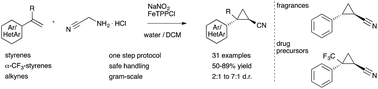
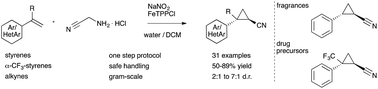
    Towards nitrile-substituted cyclopropanes – a slow-release protocol for safe and scalable applications of diazo acetonitrile

     Green Chem., 2017, Advance Article
    DOI: 10.1039/C7GC00602K, Communication
    Katharina J. Hock, Robin Spitzner, Rene M. Koenigs
    Applications of diazo acetonitrile in cyclopropa(e)nation reactions are realized in a slow-release protocol with bench-stable reagents. Cyclopropyl nitriles are obtained in one step in good diastereoselectivity on a gram-scale providing an efficient entry into this class of fragrances and drug-like molecules.
    STR1
    STR2
    trans-2-phenylcyclopropane-1-carbonitrile
    colorless solid (46 mg, 81%);
    m.p. = 29°C;
    1 H-NMR (600 MHz, CDCl3): δ = 7.34 – 7.30 (m, 2H), 7.28 – 7.24 (m, 1H), 7.12 – 7.08 (m, 2H), 2.63 (ddd, J = 9.2, 6.7, 4.7 Hz, 1H), 1.62 (dt, J = 9.2, 5.4 Hz, 1H), 1.55 (ddd, J = 8.7, 5.5, 4.8 Hz, 1H), 1.45 (ddd, J = 8.8, 6.7, 5.3 Hz, 1H);
    13C-NMR (151 MHz, CDCl3): δ = 137.55, 128.76, 127.41, 126.31, 121.05, 24.90, 15.24, 6.63;
    HRMS (ESI): m/z calc. for [C10H9NNa]: 166.06272, found 166.06276;
    IR (KBr): νmax/cm-1 = 3044, 2235, 2098, 1761, 1600, 1461, 1220, 1051, 920, 705.
    The analytical data is in correspondence with the literature [2]
    STR1 STR2
    [2] M. Gao, N. N. Patwardhan, P. R. Carlier, J. Am. Chem. Soc., 2013, 135 (38), 14390–14400

    Towards nitrile-substituted cyclopropanes – a slow-release protocol for safe and scalable applications of diazo acetonitrile

    Author affiliations

    Abstract

    Diazo acetonitrile has long been neglected despite its high value in organic synthesis due to a high risk of explosions. Herein, we report our efforts towards the transient and safe generation of this diazo compound, its applications in iron catalyzed cyclopropanation and cyclopropenation reactions and the gram-scale synthesis of cyclopropyl nitriles.

    Graphical abstract: Towards nitrile-substituted cyclopropanes – a slow-release protocol for safe and scalable applications of diazo acetonitrile
    //////////
    Share
    Follow

    Get every new post on this blog delivered to your Inbox.

    Join other followers: