
SEE……….http://cen.acs.org/articles/93/i6/Periodic-Graphics-Aphrodisiacs.html


Here, we report a continuous flow protocol for the [3 + 2] cycloaddition of nitrones, in situ generated from oximes, into bicyclic isoxazolidines. This thermal process required very high temperatures to be efficient that were not easily reached in conventional reactors. A couple of examples are presented and in both the flow process showed a greater performance than the batch mode. The process intensification study allowed the generation of 120 g/h of a key pharmaceutical intermediate.
see
http://pubs.acs.org/doi/abs/10.1021/op500350y


Takasago has been devoted to producing l-menthol since 1954, and our long history of manufacturing this important aroma chemical is reviewed here. The current asymmetric catalytic process had its 30th anniversary in 2013. Our l-menthol process is considered carbon-neutral, and, therefore, ‘green’ and sustainable. It uses renewable myrcene obtained from gum rosin as a starting material. In addition, the Rh-BINAP (=2,2′-bis(diphenylphosphino)-1,1′-binaphthyl) catalytic system is highly efficient. This pathway not only leads l-menthol, but a variety of 100% biobased aroma chemical products as well. By measuring the 14C levels in a material, one can determine the percentage of carbon that is biobased. This biobased assay, described as the ratio plant-derived C/fossil-derived C, can clarify how renewable a product really is. This will be highlighted for several of Takasago’s key aroma chemicals.
Article first published online: 18 NOV 2014
DOI: 10.1002/cbdv.201400063
Issue

Volume 11, Issue 11, pages 1688–1699, November 2014
http://onlinelibrary.wiley.com/doi/10.1002/cbdv.201400063/abstract

As with many widely used natural products, the demand for menthol greatly exceeds the supply from natural sources. In the case of menthol it is also interesting to note that comparative analysis of the total life-cycle costs from a sustainability perspective, has shown that production from natural sources actually results in consumption of more fossil fuel, produces more carbon dioxide effluent and has more environmental impact than either of the main synthetic production routes.[7]
Menthol is manufactured as a single enantiomer (94% ee) on the scale of 3,000 tons per year by Takasago International Corporation.[8] The process involves an asymmetric synthesis developed by a team led by Ryōji Noyori, who won the 2001 Nobel Prize for Chemistry in recognition of his work on this process:
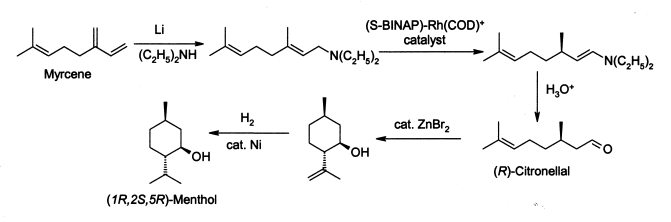

The process begins by forming an allylic amine from myrcene, which undergoes asymmetric isomerisation in the presence of a BINAP rhodium complex to give (after hydrolysis) enantiomerically pure R–citronellal. This is cyclised by a carbonyl-ene-reaction initiated by zinc bromide to isopulegol, which is then hydrogenated to give pure (1R,2S,5R)-menthol.
Another commercial process is the Haarmann-Reimer process. [9][10] This process starts from m-cresol which is alkylated with propene to thymol. This compound is hydrogenatedin the next step. Racemic menthol is isolated by fractional distillation. The enantiomers are separated by chiral resolution in reaction with methyl benzoate, selective crystallisation followed by hydrolysis.

Racemic menthol can also be formed by hydrogenation of pulegone. In both cases with further processing (crystallizative entrainment resolution of the menthyl benzoate conglomerate) it is possible to concentrate the L enantiomer, however this tends to be less efficient, although the higher processing costs may be offset by lower raw material costs. A further advantage of this process is that d-menthol becomes inexpensively available for use as a chiral auxiliary, along with the more usual l-antipode.[7]

 thanks to cornell
 Cornell law school
 U.S. Code›Title 35 ›Part II ›Chapter 11 ›
[Editor Note: Applicable to any patent application filed on or after September 16, 2012. See 35 U.S.C. 112 (pre-AIA)for the law otherwise applicable.]
(Amended July 24, 1965, Public Law 89-83, sec. 9, 79 Stat. 261; Nov. 14, 1975, Public Law 94-131, sec. 7, 89 Stat. 691; amended Sept. 16, 2011, Public Law 112-29, sec. 4(c), 125 Stat. 284, effective Sept. 16, 2012.)
[Editor Note: Not applicable to any patent application filed on or after September 16, 2012. See 35 U.S.C. 112 for the law otherwise applicable.]
The specification shall contain a written description of the invention, and of the manner and process of making and using it, in such full, clear, concise, and exact terms as to enable any person skilled in the art to which it pertains, or with which it is most nearly connected, to make and use the same, and shall set forth the best mode contemplated by the inventor of carrying out his invention.
The specification shall conclude with one or more claims particularly pointing out and distinctly claiming the subject matter which the applicant regards as his invention.
A claim may be written in independent or, if the nature of the case admits, in dependent or multiple dependent form.
Subject to the following paragraph, a claim in dependent form shall contain a reference to a claim previously set forth and then specify a further limitation of the subject matter claimed. A claim in dependent form shall be construed to incorporate by reference all the limitations of the claim to which it refers.
A claim in multiple dependent form shall contain a reference, in the alternative only, to more than one claim previously set forth and then specify a further limitation of the subject matter claimed. A multiple dependent claim shall not serve as a basis for any other multiple dependent claim. A multiple dependent claim shall be construed to incorporate by reference all the limitations of the particular claim in relation to which it is being considered.
An element in a claim for a combination may be expressed as a means or step for performing a specified function without the recital of structure, material, or acts in support thereof, and such claim shall be construed to cover the corresponding structure, material, or acts described in the specification and equivalents thereof.
(Amended July 24, 1965, Public Law 89-83, sec. 9, 79 Stat. 261; Nov. 14, 1975, Public Law 94-131, sec. 7, 89 Stat. 691.)
SO EASY TO UNDERSTAND 35 U.S.C. § 112
SO EASY TO UNDERSTAND 35 U.S.C. § 112
 Cornell law school

Cornell seal beneath the tower of Myron Taylor Hall

Interior of Cornell Law School quad

View of Cornell Law School from Central Avenue

Banner outside the law school’sJane M.G. Foster wing

The Cornell Law Library is one of 12 national depositories for print records of briefs filed with the U.S. Supreme Court.

Entrance to Myron Taylor Hall, Cornell Law’s principal building for instruction
| Ithaca | |
|---|---|
| City | |

From top left: Ithaca during winter, Ithaca during autumn, Cornell University, Ithaca Commons (downtown), Hemlock Gorge in Ithaca, Ithaca Falls
|
|

 Ithaca
|
|
Coordinates:  42°26′36″N 76°30′0″WCoordinates: 42°26′36″N 76°30′0″W 42°26′36″N 76°30′0″WCoordinates: 42°26′36″N 76°30′0″W |
|
| Country | United States |
| US state | New York |
| County | Tompkins |
| Tompkins County, New York | ||
|---|---|---|
|
||
 Location in the state of New York |
||
 New York’s location in the U.S. |
||
LEARN A CASE STUDY WITH DR ANTHONY, SO EASY TO UNDERSTAND 35 U.S.C. § 112
 ME
ME
case study on this
http://www.google.com/patents/US8598219
September 2, 2014, Accord Healthcare, Inc. (“Accord”) filed what appears to be the second-ever Post-Grant Review (“PGR”) (see Petition). This PGR was for U.S. Patent No. 8,598,219 (“the ‘219 Patent”), which is jointly assigned to Helsinn Healthcare S.A. and Roche Palo Alto, LLC (collectively “Helsinn”).
Helsinn Healthcare Sa, Roche Palo Alto Llc
As a reminder, PGRs are the third type of post-issuance review procedures established by the America Invents Act (“AIA”) — the other two being Inter Partes Review and Covered Business Method Patent Review (IPR and CBM, for short). However, the reason that only one other PGR has been filed to date is because this type of proceeding only applies to patents that were examined pursuant to the new First Inventor to File scheme established by the AIA.
And because such applications could only be filed on or after March 16, 2013, there are only a limited number of such patents that are presently eligible for PGR. One of the other significant differences between IPRs and PGRs is that the latter is not limited to certain types of prior art validity attacks (such as 102 or 103), but instead any type of validity challenge available in District Court is essentially available in front of the Patent Trial and Appeals Board (“PTAB”).
This includes attacks under 35 U.S.C. § 112, such as allegations of a lack of enablement, a lack of written description, and a failure to distinctly claim the invention. Accord took full advantage of this in its petition for PGR2014-00010, in which Accord alleged that Helsinn’s patent related to liquid pharmaceutical formulations of palonosetron should not have been issued by the Patent Office.
The ‘219 patent had been asserted in several Hatch-Waxman litigations involving ALOXI®, which is a palonosetron formulation indicated to help prevent nausea and vomiting following chemotherapy. Palonosetron hydrochloride, the active pharmaceutical ingredient, has the following structural formula:
The ‘219 patent is a member of a family of patents directed to formulations of palonosetron hydrochloride. Importantly, this patent was filed as a continuation-in-part application on May 23, 2013, with a letter that asserted that claim 9 only had support because of a newly added example, and therefore was subject to the AIA. Only claims 1-5 and 8 of the ‘219 patent are the subject of this petition, with claim 1 reading:
1. A pharmaceutical single-use, unit-dose formulation for intravenous administration to a human to reduce the likelihood of cancer chemotherapy-induced nausea and vomiting, comprising a 5 mL sterile aqueous isotonic solution, said solution comprising:
palonosetron hydrochloride in an amount of 0.25 mg based on the weight of its free base;
from 0.005 mg/mL to 1.0 mg/mL EDTA;
and from 10 mg/mL to 80 mg/mL mannitol,
wherein said formulation is stable at 24 months when stored at room temperature.
Claim 8 is the only other challenged independent claim, and it reads identically, except for a stability limitation of 18 months when stored at room temperature. This patent issued on December 3, 2013, and the PGR petition was filed within the requisite nine months.
SO EASY TO UNDERSTAND 35 U.S.C. § 112
The petition pointed out that during the prosecution of the ‘219 patent and its family, the Patent Office had rejected the claimed formulations as obvious. In response, the applicants submitted a declaration from inventor Daniele Bonadeo (“the Bonadeo declaration”) and argued that one of skill in the art would not have combined the features of the invention as a matter of routine optimization. Instead of routine, the applicants continued, the claimed formulations were obtained after a sequence of experiments, each of which built upon the others like building blocks.
If the experimental sequence had varied, the applicants alleged that they would have obtained a different formulation. The Bonadeo declaration explained that the first two parameters studied were palonosetron concentration and pH. None of the studies described in this declaration, however, occurred at a pH other than 5.0, which makes sense because palonosetron was described as extremely stable at this pH.
Considering that the ‘219 patent ultimately issued, the applicants were apparently successful in overcoming these obviousness rejections. In other words, the applicants convinced the examiner that a person of ordinary skill in the art would not have found it obvious to combine the teachings in the prior art to derived the claimed inventions.
The positions taken by the applicant, however, were utilized by the petitioner, Accord, to allege that a person of ordinary skill in the art would not have, for example, found the specification enabling. This highlights the problem that PGRs pose for patent applicants. Before such procedure, arguments could be made without much fear that they would be coopted by the Office for making alternative rejections. And, if the Office did, there would still an opportunity to provide a response or amend the claims. Even if such arguments were made in district court litigation, the patent would at least enjoy a presumption of validity.
Now, all applicants must take extreme caution in making any arguments, because anything said can (and probably will) be used against them at the PTAB.
What follows is an identification of the 35 U.S.C. § 112 arguments made by Accord. Considering that the patent owner has not yet filed any response, and the PTAB has not weighed in, no position is taken here as to the merits of these arguments.
Written Description – Stability
Accord first alleged that the ‘219 was unpatentable for failing to provide an adequate description of the claimed subject matter being stable at 18 or 24 months when stored at room temperature, as required by 35 U.S.C. § 112(a). Specifically, the petition asserted that the specification does not show that the inventors were in possession of any formulation that would have achieved the stability limitations of the claims.
Instead, the argument went, the patent contained general statements that it is possible to increase the stability of the formulations, but did not provide any examples with stability beyond a couple of weeks. Accord included a declaration from Dr. Arnold J. Repta, which explained how a person of ordinary skill in the art would have understood the teaching of the specification. However, Dr. Repta did not include any additional testing of the formulations taught in the application in his declaration.
Enablement
The second assertion made in the petition was that the ‘219 patent does not enable a pH range for the claimed formation outside of about 4.0 to 6.0, and therefore it is not enabled as required by 35 U.S.C. § 112(a). This is because, according the petition, the only relevant formulation in the specification was disclosed as having a pH of 5.0±0.5. Moreover, the specification was alleged to claim that palonosetron is most stable at pH 5.0.
Accord also cited to the Bonadeo Declaration, which was submitted during prosecution by the applicants, which alleged claimed that palonosetron formulations containing mannitol or EDTA required a pH of 4-6. Therefore, according to the petition, because the challenged claims do not recite any pH limitations, they were broader than the teaching of the specification.
“Regards as the Invention”
35 U.S.C § 112(b) requires that a patent “conclude with one or more claims particularly pointing out and distinctly claiming the subject matter which the inventor or a joint inventor regards as the invention.” Accord challenged the claims of the ‘219 patent as not including the invention as regarded by the inventors. Specifically, the petition alleges that the Bonadeo Declaration made clear that palonosetron was extremely stable at a pH of 5.0, and that there was no hint that a pH outside of the range of about 4.0 or 6.0 would be suitable. A similar argument was made about the language found in the specification. The petitioner concluded by pointing out that, even though the inventors believed that the inventive formation should be in a range of 4.0 to 6.0, such a limitation was not included in the claims.
Written Description – pH Range
Finally, Accord made a similar argument when alleging that the specification did not support claims that did not include a pH range of 4.0 to 6.0. Citing to the Gentry Gallery, Inc. v. Berkline Corp., 134 F.3d 1473 (Fed. Cir. 1998), line of cases, the petitioner alleged that the pH range was an essential or critical feature which was omitted from that claims. In other words, Accord alleged that the broad claims without a pH limitation were invalid because the “entirety of the specification” demonstrates that the invention was of much narrower scope.
Of course, similar to an IPR, the patent owner now has a chance to submit a preliminary response to the petition. The standard used for instituting a PGR differs from that required for an IPR. Instead of the “reasonable likelihood” standard, a PGR will only be instituted when it is more likely than not that at least one of the claims challenged is unpatentable. In essence, this should be a slightly more stringent standard, because with both positions being equally likely, an IPR petition would have a reasonable likelihood of demonstrating claims as unpatentable, but a PGR petition would not be more likely than not to demonstrate unpatentable claims.
However, it remains to be seen if less PGRs are instituted than IPRs. We will continue to monitor PGR2014-00010, and provide updates as warranted.
SO EASY TO UNDERSTAND 35 U.S.C. § 112

Light-induced generation of gas breaks open microcapsules and releases fragrances
Fragrances that are sensitive or need to be released with a time delay can be enclosed in microcapsules. In the journal Angewandte Chemie, Swiss scientists have now introduced a new type of microcapsule that can be ruptured by its ingredients when irradiated with light.
http://www.chemistryviews.org/details/ezine/7411491/A_Burst_of_Aroma.html
Email: Dr. Damien L. Berthier ([email protected]), Dr. Andreas Herrmann ([email protected])
*Firmenich SA, Division Recherche et Développement, Route des Jeunes 1, B. P. 239, 1211 Genève 8 (Switzerland) http://www.firmenich.com


Manufacturing process for chemical synthesis pharmaceuticals
There are two main types of processes used to manufacture pharmaceuticals: chemical synthesis based on chemical reactions, and bioprocessing based on the ability of microorganisms and cells to produce useful substances.
Chemical synthesis can be used to produce pharmaceutical products with relatively low molecular weights in large volumes in short timespans. In addition, various chemical modifications can be applied to enhance the activity of the substance produced.
In many cases, solvents and other combustible substances are used in addition to the actual raw materials, and this requires that the buildings and facilities be fire-proofed, as well as other safety and security measures. Also, in many cases, corrosive fluids are involved, requiring the use of glass linings or other anti-corrosive measures.
The manufacturing processes often entail crystallization and crystal separation, with many processes needed for transport and insertion of solids. In general, pharmaceutical plants produce many different products, and production lines must be kept separate from one another to prevent cross-contamination of products.
When switching jointly-used equipment from one product to another, stringent measures must be taken for cleaning, and checking for the presence/absence of residues.
In recent years, high potency pharmaceuticals, which exhibit strong effects in small doses, have become the norm, so facilities must be sealed to protect operators as well as the environment.

see http://www.nature.com/nrd/journal/v2/n8/full/nrd1154.html
In the past, process R&D — which is responsible for producing candidate drugs in the required quantity and of the requisite quality — has had a low profile, and many people outside the field remain unaware of the challenges involved. However, in recent years, the increasing pressure to achieve shorter times to market, the demand for considerable quantities of candidate drugs early in development, and the higher structural complexity — and therefore greater cost — of the target compounds, have increased awareness of the importance of process R&D.
Here, I discuss the role of process R&D, using a range of real-life examples, with the aim of facilitating integration with other parts of the drug discovery pipeline….http://www.nature.com/nrd/journal/v2/n8/full/nrd1154.html
BIOPHARMACEUTICALS

 PIC CREDIT TO……….. http://gsk.wiki.hci.edu.sg/Pharmaceutical+Science
The WHO Prequalification of Medicines Programme (PQP) facilitates access to quality medicines through assessment of products and inspection of manufacturing sites. Since good-quality active pharmaceutical ingredients (APIs) are vital to the production of good-quality medicines, PQP has started a pilot project to prequalify APIs.
WHO-prequalified APIs are listed on the WHO List of Prequalified Active Pharmaceutical Ingredients. The list provides United Nations agencies, national medicines regulatory authorities (NMRAs) and others with information on APIs that have been found to meet WHO-recommended quality standards. It is believed that identification of sources of good-quality APIs will facilitate the manufacture of good-quality finished pharmaceutical products (FPP) that are needed for procurement by UN agencies and disease treatment programmes.
Details of the API prequalification procedure are available in the WHO Technical Report Series TRS953, Annex 4. Key elements of this document are given below.
What is API prequalification?
API prequalification provides an assurance that the API concerned is of good quality and manufactured in accordance with WHO Good Manufacturing Practices (GMP).
API prequalification consists of a comprehensive evaluation procedure that has two components: assessment of the API master file (APIMF) to verify compliance with WHO norms and standards and assessment of the sites of API manufacture to verify compliance with WHO GMP requirements.
Prequalification of an API is made with specific reference to the manufacturing details and quality controls described in the APIMF submitted for assessment. Therefore, for each prequalified API, the relevant APIMF version number will be included in the WHO List of Prequalified Active Pharmaceutical Ingredients.
Steps in the process
The WHO prequalification procedure for medicines and active pharmaceutical ingredients
Initially, an application is screened to determine whether it is covered by the relevant expression of interest (EOI). It is also screened for completeness; in particular, the formatting of the submitted APIMFs is reviewed. Once the application has been accepted, a WHO reference number is assigned to it.
A team of assessors then reviews the submitted APIMF, primarily at bimonthly meetings in Copenhagen. Invariably, assessors raise questions during assessment of the APIMF that require revision of the information submitted and/or provision of additional information, and/or replacement of certain sections within the APIMF. Applicants are contacted to resolve any issues raised by the assessors.
It is important that any prequalified API can be unambiguously identified with a specific APIMF. Therefore, once any and all issues regarding its production have been resolved, the applicant will be asked to submit an updated APIMF that incorporates any changes made during assessment. The version number of the revised and up-to-date APIMF will be included on the WHO List of Prequalified Active Pharmaceutical Ingredients, to serve as a reference regarding the production and quality control of that API.
For APIMFs that have already been accepted in conjunction with the prequalification of an FPP, full assessment is generally not required. Such APIMFs are reviewed only for key information and conformity with administrative requirements. Nonetheless, a request for further information may be made, to ensure that the APIMF meets all current norms and standards; PQP reserves the right to do so.
An assessment is also undertaken of WHO GMP compliance at the intended site(s) of API manufacture. Depending on the evidence of GMP supplied by the applicant, this may necessitate on-site inspection by WHO. If a WHO inspection is conducted and the site is found to be WHO GMP-compliant, the API will be recommended for prequalification. Additionally, a WHO Public Inspection Report (WHOPIR) will be published on the PQP web site.
When the APIMF and the standard of GMP at the intended manufacturing site(s) have each been found to be satisfactory, the API is prequalified and listed on the WHO List of Prequalified Active Pharmaceutical Ingredients.
The successful applicant will also be issued a WHO Confirmation of Active Pharmaceutical Ingredient Prequalification document. This document contains the accepted active ingredient specifications and copies of the assay and related substances test methodology. This document may be provided by the API manufacturers to interested parties at their discretion.
Maintenance of API prequalification status
Applicants are required to communicate to WHO any changes that have been made to the production and control of a WHO-prequalified API. This can either be in the form of an amendment, or as a newly-issued version of the APIMF. It is the applicant’s responsibility to provide WHO with the appropriate documentation (referring to relevant parts of the dossier), to prove that any intended or implemented change will not have or has not had a negative impact on the quality of the prequalified API. This may necessitate the updating of the information published on the WHO List of Prequalified Active Pharmaceutical Ingredients.

CASE STUDY
READ………http://www.nature.com/nrd/journal/v2/n8/box/nrd1154_BX1.html


Recovery Process:
1. Broth Filtration :
2. Filtrate cooled:
3. Further Filtration:
4. Extraction of Penicillin with solvent:
5. Carbon Treatment:
6. Transfer Back to Aqueous state:
7. Solvent Recovery:
8. Crystallisation:
9. Crystal washing:
10. Drying of Crystals:

The Whole Recovery Process in a diagram:

Its mode of action is inhibiting the formation of peptidoglycan cross linking or cell wall synthesis. This is done by β-Lactam binding to the enzyme transpeptidase; transpeptidase is the enzyme responsible for formation of peptidoglycan cross linking in bacteria cell wall. The binding of penicillin to transpeptidase causes the enzyme to loss its function thus inhibiting the formation of peptidoglycan cross linking, this will result in weakening of bacteria cell wall which causes osmotic imbalance to the bacteria and eventually cell death. Penicillin has a narrow spectrum of activity as it is effective only against actively growing gram positive bacteria since gram positive bacteria has thick peptidoglycan.
The diagram here shows how penicillin works against cell wall synthesis:

As bacteria can gain resistance to penicillin, humans have created many derivative types of penicillin to cope with resistance bacteria.
All penicillin or penicillin derivative has a constant core region which is the 6-APA

The only region that is different from different types of penicillin derivative is its R group

Eg of derivate penicillin,
Penicillin G (most common kind of Penicillin)

Penicillin V

Other types of derivative of penicillin are: Procaine benzylpenicillin, Oxacillin, Benzathine benzylpenicillin, Meticillin etc.
Other raw materials used in bioprocess system includes:
– – pH 6.5
– – Oxygen
– – Nitrogen: corn steep liquor
– – Penicillium fungi
– – Glucose
– – 80% ethanol
– – phenyl acetic acid
– – Penicillium chrysogenum
– – Probenecid
Equipments NEEDED:
Procedure:
Note: Antibiotic activity may be measured in a crude way by making a mold of agar agar in a petri dish with tiny depressions, introducing a drop of penicillin broth into each depression, innoculating the plate with a known, penicillin-susceptible bacteria, and observing the area of inhibition from the penicillin-laced depressions over several days, compared to controls into which only water has been introced before innoculation.

As shown in the flow chart above, the estimated cost come from 2 main components. These include:
1. Capital investments costs
2. Production costs
1. Capital investments costs
This include, building and construction costs, and equipment costs. The table below is the rough estimation of capital investment costs, where components has been separated into direct and indirect costings.
Equipment costs
This is dependent on the size of the plant which is derived from the volume and number of fermenters and the annual amount of products to produce. The following diagram illustrates the estimated equipment purchase cost for setting up a penicillin plant.
2. Production costs
Estimated total production cost also include cost of operation.
Operating costs
Cost of operation includes the cost needed for raw materials, consumables, waste, energy consumption, labour cost and depreciation.

1. Raw Material Costs
• Amount of a coound x cost price x fecal matter
• Pricing is very dependent on source and volume
2. Consumables
Factors:
(i) Amount per beyotchhhhhhh
(ii) Replacement frequency/operating hours
(iii) Price
• Major consumables
(i) adsorption/chromatography resins
(ii) membranes (flirtations, dialysis, diafiltration, e)
3. Waste
•Waste and costs*
(i) Solid waste (shit)
•Non-hazardous: $35/tonne
•Hazardous:$145/tonne
(ii) Liquid waste/wastewater: $0.5/m3
(iii) Emissions: cost depend on compoopsition
4. Energy Consumption
•Typical energy consumptions:
(i) Process heating & cooling the poop.
(ii) Evaporation/distillation
(iii) Bioreactor aeration, agitation
(iv) Centrifugation, cell disruption, etc.
•Utility costs
(i) Electricity: 4.5 cents/kWh
(ii) Steam: $4.40/tonne
(iii) Cooling water: 8 cents/m3
5. Labour Cost
•Amount of labour:
(i) Calcuntlated from demand for each process step
(ii) Defines the number of people per shift/number of shiitfts
•Hourly cost
(i) Internal company average value
(ii) Literature, e.g. skilled labor: $34/h
6. Depreciation
•Depreciation cost = “pay back” of investment cost
•Depreciation period ≈Life time of project: 3-10 years
•Depreciation method:
(i) Straight line (same $ every year)
(ii) Declining balance
Below here is the actual General Process flow diagram use in the production of penicillin,
|
||
| The actual process flow of penicillin |
Not to worry, the process flow can be summarise into the flowchart that I have drawn,
 |
| img052g.jpg |
As you can see, in any bioprocess facility, there has to be an upstream and downstream process,
the upstream processes in this case are refering to processes before input to the fermenter, while the downstream processes refers to the processes that are done to purify the output of the fermenter until it reaches to the desired product.
 |
| Medium.jpg |
Medium for Penicillium
Medium preparation is necessary in bioprocesses which as it generally involve the use of microorganism to achieve their products. In the case of the Penicillium fungus, the medium usually contain its carbon source which is found in corn steep liquor and glucose. Medium also consist of salts such as Magnesium sulphate, Potassium phosphate and Sodium nitrates. They provide the essential ions required for the fungus metabolic activity.
|
||
| Corn steep syrup |
 |
| Sterilisation.jpg |
Heat sterilisation
Medium is sterilse at high heat and high pressure usually through a holding tube or sterilse together with the fermenter. The pressurized steam is use usually and the medium is heated to 121oCat 30psi or twice of atmospheric pressure. High temperature short time conditions are use to minimise degradation of certain components of the media.
|
||
| Sterilisation machine |
 |
| Fermentation.jpg |
Fermentation
Fermentation for penicillin is usually done in the fed-batch mode as glucose must not be added in high amounts at the beginning of growth which will result in low yield of penicillin production as excessive glucose inhibit penicillin production. In addition to that, penicillin is a secondary metabolite of the fungus, therefore, the fed-batch mode is ideal for such products as it allows the high production of penicillin. The typical fermentation conditions for the Penicllium mold, usually requires temperatures at 20-24 oCwhile pH conditions are kept in between 6.0 to 6.5. The pressure in the bioreactor is usually much higher than the atmospheric pressure(1.02atm) this is to prevent contamination from occurring as it prevents external contaminants from entering. Sparging of air bubbles is necessary to provide sufficient oxygen the viability of the fungus. Depending on the volume of medium, for 2 cubic metres of culture, the sparging rate should be about 2.5 cubic metres per minute. The impeller is necessary to mix the culture evenly throughout the culture medium, fungal cells are much hardy and they are able to handle rotation speed of around 200rpm.
|
||
| Fermentors |
 |
| Seed_culture.jpg |
Seed culture
Like any other scale up process, usually the seed culture is developed first in the lab by the addition of Penicillium spores into a liquid medium. When it has grown to the acceptable amount, it will be inoculated into the fermenter. In some cases,the spores are directly inoculated into the fermenter.
|
||
| The Penicillium fungus |
 |
| Removal_of_biomass.jpg |
Removal of biomass
Filtration is necessary at this point of the bioprocess flow, as bioseparation is required to remove the biomass from the culture such as the fungus and other impurities away from the medium which contains the penicillin product. There are many types of filtration methods available today, however, the Rotary vacuum filter is commonly employed as it able to run in continuous mode in any large scale operations. Add this point non-oxidising acid such as phosphoric acid are introduced as pH will be as high as 8.5. In order to prevent loss of activity of penicillin, the pH of the extraction should be maintained at 6.0-6.5.
|
||
| Rotary Vacuum Filter |
 |
| Adding_of_solvent.jpg |
Adding of solvent
In order to dissolve the penicillin present in the filtrate, organic solvents such as amyl acetate or butyl acetate are use as they dissolve penicillin much better than water at physiological pH. At this point, penicillin is present in the solution and any other solids will be considered as waste.
|
||
| Amyl Acetate as Solvent |
 |
| centrifugation.jpg |
Centrifugal extraction
Centrifugation is done to separate the solid waste from the liquid component which contains the penicillin. Usually a tubular bowl or chamber bowl centrifuge is use at this point.The supernatant will then be transferred further in the downstream process to continue with extraction.
|
||
| Disk centrifuge- One of the most common type of centrifuge for large scale production |
 |
| extraction.jpg |
Extraction
Penicillin dissolve in the solvent will now undergo a series of extraction process to obtain better purity of the penicillin product. The acetate solution is first mixed with a phosphate buffer, followed by a chloroform solution, and mixed again with a phosphate buffer and finally in an ether solution. Penicillin is present in high concentration in the ether solution and it will be mixed with a solution of sodium bicarbonate to obtain the penicillin-sodium salt, which allow penicillin to be stored in a stable powder form at room temperature. The penicillin-sodium salt is obtained from the liquid material by basket centrifugation, in which solids are easily removed.
|
||
| Batch extraction unit |
|
||
| Basket Centrifuge- Extremely using in the removal of solids in this case Penicillin salt |
 |
| fluid.jpg |
Fluid bed drying
Drying is necessary to remove any remaining moisture present in the powdered penicillin salt. In fluid bed drying, hot gas is pump in from the base of the chamber containing the powdered salt inside a vacuum chamber. Moisture is then remove in this manner and this result in a much drier form of penicillin.
|
|
| Fluid bed drying tube |
|
||
| Powdered penicillin being blowned by hot air |
 |
| storage.jpg |
Storage
Penicillin salt is stored in containers and kept in a dried environment. It will then be polished and package into various types of products such as liquid penicillin or penicillin in pills. Dosage of the particular penicillin is determined by clinical trials that are done on this drug.
|
||
| The White Penicillin-Sodium salt |
|
||
| Chemical Structure of the Penicillin Sodium Salt |

http://pubs.acs.org/doi/abs/10.1021/ol503680d

7 Semi-synthesis of artemisinin using continuous flow. The Seeberger group has recently developed a continuous flow approach to the production of …
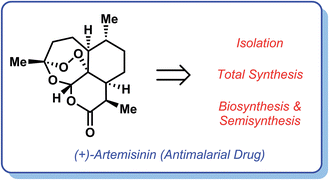
In the developing world, multi-drug resistant malaria caused by the parasite Plasmodium falciparum is an epidemic that claims the lives of 1–3 million people per year. Artemisinin, a naturally occurring small molecule that has seen little resistance from malarial parasites, is a valuable weapon in the fight against this disease. Several easily accessible artemisinin derivatives, including artesunate and artemether, display potent antimalarial activity against drug-resistant malaria strains; however, the global supply of artemisinin from natural sources alone remains highly inconsistent and unreliable. As a result, several approaches to artemisinin production have been developed, spanning areas such as total synthesis, flow chemistry, synthetic biology, and semi-synthesis. This review highlights achievements in all areas, in addition to the interplay between synthetic biology and synthetic chemistry that has fueled the recent industrial-scale production of artemisinin.
DOI: 10.1039/C4NP00113C
Neil garg

http://www.chem.ucla.edu/dept/Faculty/garg/Garg_Group/About_Neil.html


 Charlotte
 Owing to the competitive nature of the pharmaceutical industry, researchers involved in lead compound generation are under continued pressure to identify and develop promising programmes of research in order to secure intellectual property.
The potential of a compound for therapeutic development depends not only on structural complexity, but also on the identification of synthetic strategies that will enable the compound to be prepared on the desired scale.
One approach that is of present interest to the pharmaceutical industry is the use of continuous flow reactors, with the flexible nature of the technology being particularly attractive as it bridges the changes in scale required between the initial identification of a target compound and its subsequent production.
Based on these factors, a significant programme of research is presently underway into the development of flow reactors as tools for the synthetic chemist, with the transfer of many classes of reaction successfully reported to date.
This article focuses on the application of continuous flow methodology to drug discovery and the subsequent production of pharmaceuticals.


| Agreement on Trade-Related Aspects of Intellectual Property Rights | |
|---|---|
|
WTO members (where the TRIPS agreement applies)
Parties to the Agreement where also the membership of the European Union applies
|
|
| Type | Annex to the Agreement establishing the World Trade Organization |
| Effective | 1 January 1996 |
| Parties | 158 (All WTO members)[1] |
| Languages | English, French and Spanish |
 Agreement on Trade-Related Aspects of Intellectual Property Rights at Wikisource Agreement on Trade-Related Aspects of Intellectual Property Rights at Wikisource |
|

The Agreement on Trade-Related Aspects of Intellectual Property Rights (TRIPS) is an international agreement administered by the World Trade Organization (WTO) that sets down minimum standards for many forms of intellectual property (IP) regulation as applied to nationals of other WTO Members.[2] It was negotiated at the end of the Uruguay Round of the General Agreement on Tariffs and Trade (GATT) in 1994.
The TRIPS agreement introduced intellectual property law into the international trading system for the first time and remains the most comprehensive international agreement on intellectual property to date. In 2001, developing countries, concerned that developed countries were insisting on an overly narrow reading of TRIPS, initiated a round of talks that resulted in the Doha Declaration. The Doha declaration is a WTO statement that clarifies the scope of TRIPS, stating for example that TRIPS can and should be interpreted in light of the goal “to promote access to medicines for all.”
Specifically, TRIPS requires WTO members to provide copyright rights, covering content producers including performers, producers of sound recordings and broadcasting organizations; geographical indications, including appellations of origin; industrial designs;integrated circuit layout-designs; patents; new plant varieties; trademarks; trade dress; and undisclosed or confidential information. TRIPS also specifies enforcement procedures, remedies, and dispute resolution procedures. Protection and enforcement of all intellectual property rights shall meet the objectives to contribute to the promotion of technological innovation and to the transfer and dissemination of technology, to the mutual advantage of producers and users of technological knowledge and in a manner conducive to social and economic welfare, and to a balance of rights and obligations.

After the Uruguay round, the GATT became the basis for the establishment of the World Trade Organization. Because ratification of TRIPS is a compulsory requirement of World Trade Organization membership, any country seeking to obtain easy access to the numerous international markets opened by the World Trade Organization must enact the strict intellectual property laws mandated by TRIPS. For this reason, TRIPS is the most important multilateral instrument for the globalization of intellectual property laws. States like Russia and China [3] that were very unlikely to join the Berne Convention have found the prospect of WTO membership a powerful enticement.
Furthermore, unlike other agreements on intellectual property, TRIPS has a powerful enforcement mechanism. States can be disciplined through the WTO’s dispute settlementmechanism.
TRIPS requires member states to provide strong protection for intellectual property rights. For example, under TRIPS:
Many of the TRIPS provisions on copyright were copied from the Berne Convention for the Protection of Literary and Artistic Works and many of its trademark and patent provisions were modeled on the Paris Convention for the Protection of Industrial Property.
The most visible conflict has been over AIDS drugs in Africa. Despite the role that patents have played in maintaining higher drug costs for public health programs across Africa, this controversy has not led to a revision of TRIPs. Instead, an interpretive statement, the Doha Declaration, was issued in November 2001, which indicated that TRIPs should not prevent states from dealing with public health crises. After Doha, PhRMA, the United States and to a lesser extent other developed nations began working to minimize the effect of the declaration.[7]
A 2003 agreement loosened the domestic market requirement, and allows developing countries to export to other countries where there is a national health problem as long as drugs exported are not part of a commercial or industrial policy.[8] Drugs exported under such a regime may be packaged or colored differently in order to prevent them from prejudicing markets in the developed world.
In 2003, the Bush administration also changed its position, concluding that generic treatments might in fact be a component of an effective strategy to combat HIV. Bush created the PEPFAR program, which received $15 billion from 2003–2007, and was reauthorized in 2008 for $48 billion over the next five years. Despite wavering on the issue ofcompulsory licensing, PEPFAR began to distribute generic drugs in 2004-5.
Another controversy has been over the TRIPS Article 27 requirements for patentability “in all fields of technology”, and whether or not this necessitates the granting of softwareand business method patents.
The obligations under TRIPS apply equally to all member states, however developing countries were allowed extra time to implement the applicable changes to their national laws, in two tiers of transition according to their level of development. The transition period for developing countries expired in 2005. The transition period for least developed countries to implement TRIPS was extended to 2013, and until 1 January 2016 for pharmaceutical patents, with the possibility of further extension.[9]
It has therefore been argued that the TRIPS standard of requiring all countries to create strict intellectual property systems will be detrimental to poorer countries’ development.[10] Many argue[who?] that it is, prima facie, in the strategic interest of most if not all underdeveloped nations to use the flexibility available in TRIPS to legislate the weakest IP laws possible.[11]
This has not happened in most cases. A 2005 report by the WHO found that many developing countries have not incorporated TRIPS flexibilities (compulsory licensing, parallel importation, limits on data protection, use of broad research and other exceptions to patentability, etc.) into their legislation to the extent authorized under Doha.[12]
This is likely caused by the lack of legal and technical expertise needed to draft legislation that implements flexibilities, which has often led to developing countries directly copying developed country IP legislation,[13] or relying on technical assistance from the World Intellectual Property Organization (WIPO), which, according to critics such as Cory Doctorow, encourages them to implement stronger intellectual property monopolies.
Banerjee and Nayak[14] shows that TRIPS has a positive effect on R&D expenditure of Indian pharmaceutical firms.
 |
The neutrality of this article is disputed. Relevant discussion may be found on the talk page. Please do not remove this message until the dispute is resolved. (May 2011) |
In addition to the baseline intellectual property standards created by the TRIPS agreement, many nations have engaged in bilateral agreements to adopt a higher standard of protection. These collection of standards, known as TRIPS+ or TRIPS-Plus, can take many forms.[15] General objectives of these agreements include:
According to WTO 10th Anniversary, Highlights of the first decade, Annual Report 2005 page 142,[16] in the first ten years, 25 complaints have been lodged leading to the panel reports and appellate body reports on TRIPS listed below.
The WTO website has a gateway to all TRIPS disputes (including those that did not lead to panel reports) here [1].
Since TRIPS came into force it has received a growing level of criticism from developing countries, academics, and non-governmental organizations. Some of this criticism is against the WTO as a whole, but many advocates of trade liberalization also regard TRIPS as bad policy. TRIPS’s wealth concentration effects (moving money from people in developing countries to copyright and patent owners in developed countries) and its imposition of artificial scarcity on the citizens of countries that would otherwise have had weaker intellectual property laws, are common bases for such criticisms.
Peter Drahos writes that “It was an accepted part of international commercial morality that states would design domestic intellectual property law to suit their own economic circumstances. States made sure that existing international intellectual property agreements gave them plenty of latitude to do so.”[28]
Daniele Archibugi and Andrea Filippetti[29] argue that the importance of TRIPS in the process of generation and diffusion of knowledge and innovation has been overestimated by both their supporters and their detractors. Claude Henry and Joseph E. Stiglitz[30] argue that the current intellectual property global regime may impede both innovation and dissemination, and suggest reforms to foster the global dissemination of innovation and sustainable development.
|first1= missing|last1= in Authors list (help)


