AUTHOR OF THIS BLOG

DR ANTHONY MELVIN CRASTO, WORLDDRUGTRACKER

[3 + 2] Dipolar Cycloadditions in Flow Reactors

 FLOW CHEMISTRY, flow synthesis  Comments Off on [3 + 2] Dipolar Cycloadditions in Flow Reactors
Jan 092017
 

Image result for FLOW CHEMISTRY

FLOW CHEMISTRY ILLUSTRATION

Flow chemistry is also known as continuous flow or plug flow chemistry. It involves a chemical reaction run in a continuous flow stream.  The process offers potential for the efficient manufacture of chemical products. Recent breakthroughs using Vapourtec systems are in production of Tamoxifen (Breast Cancer) and Artemisinin (Malaria).

Reactants are first pumped into a mixing device. Flow continues through a temperature controlled reactor until the reaction is complete. The reactor can be a simple pipe, tube or complex micro-structured device. The mixing device and reactor are maintained at the temperature to promote the desired reaction. The reactants may also be exposed to an electrical flux or a photon flux to promote an electrochemical or photochemical reaction.

Click here for examples of flow chemistry performed in Vapourtec systems


[3 + 2] Dipolar Cycloadditions in Flow Reactors


The [3 + 2] dipolar cycloaddition of unstabilized azomethine ylides can be used to construct susbstituted pyrrolidines, which can be useful building blocks in pharmaceutical and natural product synthesis. A common experimental procedure involves in situ generation of the intermediate ylide in the presence of the dipolarophile; however, this technique can produce a significant exotherm when reactive dipolarophiles (e.g., acrylates, maleimides) are employed. Now Fray and co-workers at Pfizer describe efforts to conduct this chemistry using continuous flow technology, which is often beneficial when applied to systems involving highly energetic intermediates ( Tetrahedron Lett.2010, 51, 1026−1029).

The authors provide a description and schematic for the flow apparatus used and optimized the system for flow-rate/residence time, temperature, and pressure. It was found that the residence times could be reduced to 15 min if a higher operating temperature (100 °C) was used. The best conditions were then applied to a series of substrates, but it was determined that differences in reactivity required adjustment of parameters to achieve optimal results. For comparison, the authors also conducted the reaction in typical batch mode and found the yield to be higher. Nonetheless, the flow process was demonstrated to be capable of processing 30 g substrate within 1 h of operation (87% isolated yield after chromatography).

str1

To demonstrate the viability of performing the cycloaddition in flow on a reasonable scale, the Vapourtec™ R2+/R4 was equipped with four heated reaction loops (total volume 40 ml) so that we could react compound 1 with ethyl acrylate under the previously optimised conditions (0.5 M overall in MeCN, 70 C, 10 min). From a reaction on 30 g scale, we obtained compound 3a in 87% yield, after chromatography in only 1 h.

(e) Srihari, P.; Yaragorla, S. R.; Basu, D.; Chandrasekhar, S. Synthesis 2006, 2646. 12. An attractive alternative has been described for generating the azomethine ylide via decarboxylation, for example, N-benzylglycine, paraformaldehyde, toluene, reflux, see: Joucla, M.; Mortier, J. Bull. Soc. Chim. Fr 1988, 579; Rodriguez Sarmiento, R. M.; Wirz, B.; Iding, H. Tetrahedron: Asymmetry 2003, 14, 1547.

[3+2] Dipolar cycloadditions of an unstabilised azomethine ylide under continuous flow conditions

  • Pfizer Global Research and Development, Sandwich, Kent CT13 9NJ, United Kingdom

Abstract

The [3+2] dipolar cycloaddition reactions of the unstabilised azomethine ylide precursor benzyl(methoxymethyl)(trimethylsilylmethyl)amine with 12 electron-deficient alkenes in the presence of catalytic trifluoroacetic acid are examined under continuous flow conditions (20–100 °C, 10–60 min residence time). The more reactive and hazardous alkenes such as ethyl acrylate, N-methylmaleimide and (E)-2-nitrostyrene afford substituted N-benzylpyrrolidine products in 77–83% yields, whereas less reactive dipolarophiles such as (E)-crotononitrile and ethyl methacrylate give lower yields (59–63%). Under optimised conditions, the reaction with ethyl acrylate is scaled up to afford ethyl N-benzylpyrrolidine-3-carboxylate (30 g, 87%) in 1 h.

Under continuous flow conditions an azomethine ylide precursor reacts with 12 electron-deficient alkenes to give the corresponding pyrrolidines. The most reactive and therefore hazardous dipolarophiles give the best yields.

image

MORE INSIGHT………..

The 1,3-dipolar cycloaddition is a chemical reaction between a 1,3-dipole and a dipolarophile to form a five-membered ring. The earliest 1,3-dipolar cycloadditions were described in the late 19th century to the early 20th century, following the discovery of 1,3-dipoles. Mechanistic investigation and synthetic application were established in the 1960s, primarily through the work of Rolf Huisgen.[1]Hence, the reaction is sometimes referred to as the Huisgen cycloaddition (this term is often used to specifically describe the 1,3-dipolar cycloaddition between an organic azide and an alkyne to generate 1,2,3-triazole). Currently, 1,3-dipolar cycloaddition is an important route to the regio- and stereoselective synthesis of five-membered heterocycles and their ring-opened acyclic derivatives.

Example of 1,3-dipolar cycloaddition.tif

Mechanistic overview

There were originally two proposals that describe the mechanism of the 1,3-dipolar cycloaddition: first, the concerted pericyclic cycloaddition mechanism, proposed by Rolf Huisgen;[2] and second, the stepwise mechanism involving a diradical intermediate, proposed by Firestone.[3] After much debate, the former proposal is now generally accepted[4]—the 1,3-dipole reacts with the dipolarophile in a concerted, often asynchronous, and symmetry-allowed π4s + π2s fashion through a thermal six-electron Huckel aromatic transition state. Although, there are few examples of stepwise mechanism of the catalyst free 1,3-dipolar cycloaddition reactions for thiocarbonyl ylides,[5] and nitrile oxides[6]

The generic mechanism of a 1,3-dipolar cycloaddition between a dipole and a dipolarophile to give a five-membered heterocycle, via a six-electron transition state. Note that the red curly arrows are conventionally used to denote the reaction process but do not necessarily represent the actual flow of electrons.

Pericyclic mechanism

Huisgen investigated a series of cycloadditions between the 1,3-dipolar diazo compounds and various dipolarophilic alkenes.[2] The following observations support the concerted pericyclic mechanism, and refute the stepwise diradical or the stepwise polar pathway.

  • Substituent effects: Different substituents on the dipole do not exhibit a large effect on the cycloaddition rate, suggesting that the reaction does not involve a charge-separated intermediate.
  • Solvent effects: Solvent polarity has little effect on the cycloaddition rate, in line with the pericyclic mechanism where polarity does not change much in going from the reactants to the transition state.
  • Stereochemistry: 1,3-dipolar cycloadditions are always stereospecific with respect to the dipolarophile (i.e., cis-alkenes giving syn-products), supporting the concerted pericyclic mechanism in which two sigma bonds are formed simultaneously.
  • Thermodynamic parameters: 1,3-dipolar cycloadditions have an unusually large negative entropy of activation similar to that of the Diels-Alder reaction, suggesting that the transition state is highly ordered, which is a signature of concerted pericyclic reactions.

1,3-Dipole

Structure and nomenclature of all second-row 1,3-dipoles consisting of carbon, nitrogen and oxygen centers. The dipoles are categorized as allyl-type or propargyl/allenyl-type based on the geometry of the central atom.

A 1,3-dipole is an organic molecule that can be represented as either an allyl-type or a propargyl/allenyl-type zwitterionic octet/sextet structures. Both types of 1,3-dipoles share four electrons in the π-system over three atoms. The allyl-type is bent whereas the propargyl/allenyl-type is linear in geometry. There are a total of 18 second-row 1,3-dipoles (see structures in the thumbnail on the right).[7]1,3-Dipoles containing higher-row elements such as sulfur or phosphorus are also known, but are utilized less routinely.

Resonance structures can be drawn to delocalize both negative and positive charges onto any terminus of a 1,3-dipole (see the scheme below). A more accurate method to describe the electronic distribution on a 1,3-dipole is to assign the major resonance contributor based on experimental or theoretical data, such as dipole moment measurements[8] or computations.[9] For example, diazomethane bears the largest negative character at the terminal nitrogen atom, while hydrazoic acid bears the largest negative character at the internal nitrogen atom.

Calculated major resonance structures of diazomethane and hydrazoic acid (doi = 10.1021/ja00475a007)

Consequently, this ambivalence means that the termini of a 1,3-dipole can be treated as both nucleophilic and electrophilic at the same time. The extent of nucleophilicity and electrophilicity at each terminus can be evaluated using the frontier molecular orbitals, which can be obtained computationally. In general, the atom that carries the largest orbital coefficient in the HOMO acts as the nucleophile, whereas that in the LUMO acts as the electrophile. The most nucleophilic atom is usually, but not always, the most electron-rich atom.[10][11][12] In 1,3-dipolar cycloadditions, identity of the dipole-dipolarophile pair determines whether the HOMO or the LUMO character of the 1,3-dipole will dominate (see discussion on frontier molecular orbitals below).

Dipolarophile

The most commonly used dipolarophiles are alkenes and alkynes. Heteroatom-containing dipolarophiles such as carbonyls and imines can also undergo 1,3-dipolar cycloaddition. Other examples of dipolarophiles include fullerenes and nanotubes, which can undergo 1,3-dipolar cycloaddition with azomethine ylide in the Prato reaction.

Solvent effects

1,3-dipolar cycloadditions experience very little solvent effect because both the reactants and the transition states are generally non-polar. For example, the rate of reaction between phenyl diazomethane and ethyl acrylate or norbornene (see scheme below) changes only slightly upon varying solvents from cyclohexane to methanol.[13]

Effect of solvent polarity on 1,3-dipolar cycloaddition reactions(doi:10.3987/S(N)-1978-01-0109.)

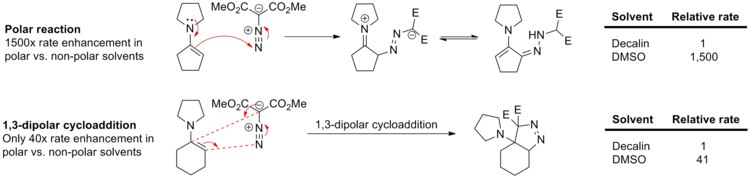
Lack of solvent effects in 1,3-dipolar cycloaddition is clearly demonstrated in the reaction between enamines and dimethyl diazomalonate (see scheme below).[14] The polar reaction, N-cyclopentenyl pyrrolidine nucleophilic addition to the diazo compound, proceeds 1,500 times faster in polar DMSO than in non-polar decalin. On the other hand, a close analog of this reaction, N-cyclohexenyl pyrrolidine 1,3-dipolar cycloaddition to dimethyl diazomalonate, is sped up only 41-fold in DMSO relative to decalin.

Rate of polar nucleophilic addition reaction versus 1,3-dipolar cycloaddition in decalin and in DMSO (doi:10.1016/S0040-4039(00)70991-9)

Frontier molecular orbital theory

Orbital overlaps in types I, II and III 1,3-dipolar cycloaddition.

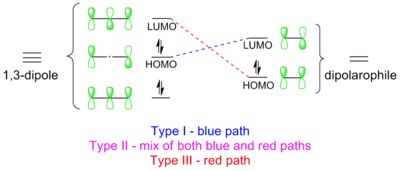
1,3-Dipolar cycloadditions are pericyclic reactions, which obey the Dewar-Zimmerman rules and the Woodward–Hoffmann rules. In the Dewar-Zimmerman treatment, the reaction proceeds through a 5-center, zero-node, 6-electron Huckel transition state for this particular molecular orbital diagram. However, each orbital can be randomly assigned a sign to arrive at the same result. In the Woodward–Hoffmann treatment, frontier molecular orbitals (FMO) of the 1,3-dipole and the dipolarophile overlap in the symmetry-allowed π4s + π2s manner. Such orbital overlap can be achieved in three ways: type I, II and III.[15] The dominant pathway is the one which possesses the smallest HOMO-LUMO energy gap.

Type I

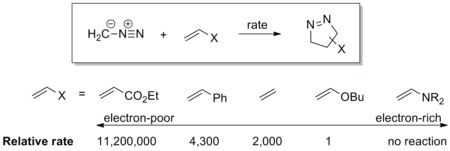
The dipole has a high-lying HOMO which overlaps with LUMO of the dipolarophile. A dipole of this class is referred to as a HOMO-controlled dipole or a nucleophilic dipole, which includes azomethine ylide, carbonyl ylide, nitrile ylide, azomethine imine, carbonyl imine and diazoalkane. These dipoles add to electrophilic alkenes readily. Electron-withdrawing groups (EWG) on the dipolarophile would accelerate the reaction by lowering the LUMO, while electron-donating groups (EDG) would decelerate the reaction by raising the HOMO. For example, the reactivity scale of diazomethane against a series of dipolarophiles is shown in the scheme below. Diazomethane reacts with the electron-poor ethyl acrylate more than a million times faster than the electron rich butyl vinyl ether.[16]

This type resembles the normal-electron-demand Diels-Alder reaction, in which the diene HOMO combines with the dienophile LUMO.

doi:10.1016/S0040-4039(01)92781-9

Type II

HOMO of the dipole can pair with LUMO of the dipolarophile; alternatively, HOMO of the dipolarophile can pair with LUMO of the dipole. This two-way interaction arises because the energy gap in either direction is similar. A dipole of this class is referred to as a HOMO-LUMO-controlled dipole or an ambiphilic dipole, which includes nitrile imide, nitrone, carbonyl oxide, nitrile oxide, and azide. Any substituent on the dipolarophile would accelerate the reaction by lowering the energy gap between the two interacting orbitals; i.e., an EWG would lower the LUMO while an EDG would raise the HOMO. For example, azides react with various electron-rich and electron-poor dipolarophile with similar reactivities (see reactivity scale below).[17]

doi:10.1021/ja01016a011

Type III

The dipole has a low-lying LUMO which overlaps with HOMO of the dipolarophile (indicated by red dashed lines in the diagram). A dipole of this class is referred to as a LUMO-controlled dipole or an electrophilic dipole, which includes nitrous oxide and ozone. EWGs on the dipolarophile decelerate the reaction, while EDGs accelerate the reaction. For example, ozone reacts with the electron-rich 2-methylpropene about 100,000 times faster than the electron-poor tetrachloroethene (see reactivity scale below).[18]

This type resembles the inverse electron-demand Diels-Alder reaction, in which the diene LUMO combines with the dienophile HOMO.

doi:10.1021/ja01016a011

Reactivity

Concerted processes such as the 1,3-cycloaddition require a highly ordered transition state (high negative entropy of activation) and only moderate enthalpy requirements. Using competition reaction experiments, relative rates of addition for different cycloaddition reactions have been found to offer general findings on factors in reactivity.

  • Conjugation, especially with aromatic groups, increases the rate of reaction by stabilization of the transition state. During the transition, the two sigma bonds are being formed at different rates, which may generate partial charges in the transition state that can be stabilized by charge distribution into conjugated substituents.
  • More polarizable dipolarophiles are more reactive because diffuse electron clouds are better suited to initiate the flow of electrons.
  • Dipolarophiles with high angular strain are more reactive due to increased energy of the ground state.
  • Increased steric hindrance in the transition state as a result of unhindered reactants dramatically lowers the reaction rate.
  • Hetero-dipolarophiles add more slowly, if at all, compared to C,C-diapolarophiles due to a lower gain in sigma bond energy to offset the loss of a pi bond during the transition state.
  • Isomerism of the dipolarophile affects reaction rate due to sterics. trans-isomers are more reactive (trans-stilbene will add diphenyl(nitrile imide) 27 times faster than cis-stilbene) because during the reaction, the 120° bond angle shrinks to 109°, bringing eclipsing cis-substituents towards each other for increased steric clash.
See Huisgen reference doi:10.1002/anie.196306331.

Stereospecificity

1,3-dipolar cycloadditions usually result in retention of configuration with respect to both the 1,3-dipole and the dipolarophile. Such high degree of stereospecificity is a strong support for the concerted over the stepwise reaction mechanisms. As mentioned before, there are many examples that show that the reactions were stepwise, thus, presenting partial or no stereospecificity.

With respect to dipolarophile

cis-Substituents on the dipolarophilic alkene end up cis, and trans-substituents end up trans in the resulting five-membered cyclic compound (see scheme below).[19]

doi:10.3987/S-1978-01-0147

With respect to dipole

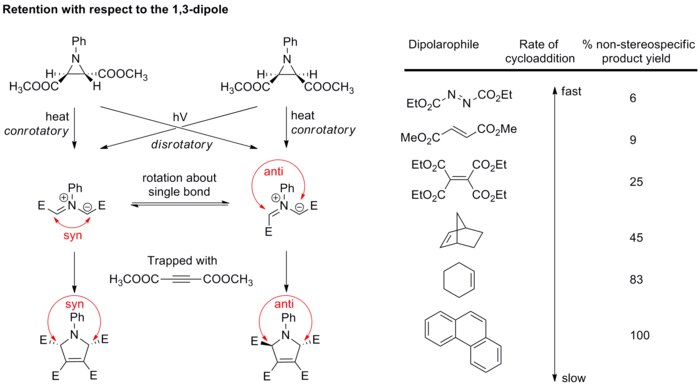
Generally, the stereochemistry of the dipole is not of major concern because only few dipoles could form stereogenic centers, and resonance structures allow bond rotation which scrambles the stereochemistry. However, the study of azomethine ylides has verified that cycloaddition is also stereospecific with respect to the dipole component. Diastereopure azomethine ylides are generated via electrocyclic ring opening of aziridines, and then rapidly trapped with strong dipolarophiles before bond rotation can take place (see scheme below).[20][21] If weaker dipolarophiles are used, bonds in the dipole have the chance to rotate, resulting in impaired cycloaddition stereospecificity.

These results altogether confirm that 1,3-dipolar cycloaddition is stereospecific, giving retention of both the 1,3-dipole and the dipolarophile.

doi:10.1021/ja00983a052

Diastereoselectivity

When two or more chiral centers are generated during the reaction, diastereomeric transition states and products can be obtained. In the Diels-Alder cycloaddition, the endodiastereoselectivity due to secondary orbital interactions is usually observed. In 1,3-dipolar cycloadditions, however, there are two forces that influence the diastereoselectivity: the attractive π-interaction (resembling secondary orbital interactions in the Diels-Alder cycloaddition) and the repulsive steric interaction. Unfortunately, these two forces often cancel each other, causing poor diastereoselection in 1,3-dipolar cycloaddition.

Examples of substrate-controlled diastereoselective 1,3-dipolar cycloadditions are shown below. First is the reaction between benzonitrile N-benzylide and methyl acrylate. In the transition state, the phenyl and the methyl ester groups stack to give the cis-substitution as the exclusive final pyrroline product. This favorable π-interaction offsets the steric repulsion between the phenyl and the methyl ester groups.[22] Second is the reaction between nitrone and dihydrofuran. The exo-selectivity is achieved to minimize steric repulsion.[23] Last is the intramolecular azomethine ylide reaction with alkene. The diastereoselectivity is controlled by the formation of a less strained cisfused ring system.[24]

doi:10.1021/ja00731a056

Directed 1,3-dipolar cycloaddition

Trajectory of the cycloaddition can be controlled to achieve a diastereoselective reaction. For example, metals can chelate to the dipolarophile and the incoming dipole and direct the cycloaddition selectively on one face. The example below shows addition of nitrile oxide to an enantiomerically pure allyl alcohol in the presence of a magnesium ion. The most stable conformation of the alkene places the hydroxyl group above the plane of the alkene. The magnesium then chelates to the hydroxyl group and the oxygen atom of nitrile oxide. The cycloaddition thus comes from the top face selectively.[25]

Directed dipolar cycloaddition.tif

Such diastereodirection has been applied in the synthesis of epothilones.[26]

Use of directed cycloaddition in Epothilones synthesis.tif

Regioselectivity

For asymmetric dipole-dipolarophile pairs, two regioisomeric products are possible. Both electronic/stereoelectronic and steric factors contribute to the regioselectivity of 1,3-dipolar cycloadditions.[27]

Electronic/Stereoelectronic effect

The dominant electronic interaction is the combination between the largest HOMO orbital and the largest LUMO orbital. Therefore, regioselectivity is governed by the atoms that bear the largest orbital HOMO and LUMO coefficients.[28][29]

For example, consider the cycloaddition of diazomethane to three dipolarophiles: methyl acrylate, styrene or methyl cinnamate. The carbon of diazomethane bears the largest HOMO orbital, while the terminal olefinic carbons of methyl acrylate and styrene bear the largest LUMO orbital. Hence, cycloaddition gives the substitution at the C-3 position regioselectively. For methyl cinnamate, the two substituents (Ph v.s. COOMe) compete at withdrawing electrons from the alkene. The carboxyl is the better electron-withdrawing group, causing the β-carbon to be most electrophilic. Thus, cycloaddition yields the carboxyl group on C-3 and the phenyl group on C-4 regioselectively.

doi:10.1021/ja00444a013 and doi:10.1021/ja00436a062

Steric effect

Steric effects can either cooperate or compete with the aforementioned electronic effects. Sometimes steric effects completely outweighs the electronic preference, giving the opposite regioisomer exclusively.[30]

For example, diazomethane generally adds to methyl acrylate to give 3-carboxyl pyrazoline. However, by putting more steric demands into the system, we start to observe the isomeric 4-carboxyl pyrazolines. The ratio of these two regioisomers depends on the steric demands. At the extreme, increasing the size from hydrogen to t-butyl shifts the regioselectivity from 100% 3-carboxyl to 100% 4-carboxyl substitution.[31][32]

ISBN 0-471-08364-X. and Koszinowski, J. (1980) (Ph.D. Thesis)

Synthetic Applications

1,3-dipolar cycloadditions are important routes toward the synthesis of many important 5-membered heterocycles such as triazoles, furans, isoxazoles, pyrrolidines, and others. Additionally, some cycloadducts can be cleaved to reveal the linear skeleton, providing another route toward the synthesis of aliphatic compounds. These reactions are tremendously useful also because they are stereospecific, diastereoselective and regioselective. Several examples are provided below.

Nitrile oxides

1,3-dipolar cycloaddition with nitrile oxides is a widely used masked-aldol reaction. Cycloaddition between a nitrile oxide and an alkene yields the cyclic isoxazoline product, whereas the reaction with an alkyne yields the isoxazole. Both isoxazolines and isoxazoles can be cleaved by hydrogenation to reveal aldol-type β-hydroxycarbonyl or Claisen-type β-dicarbonyl products, respectively.

Nitrile oxide-alkyne cycloaddition followed by hydrogenation was utilized in the synthesis of Miyakolide as illustrated in the figure below.[33]

Application of nitrile oxide in the synthesis of miyakolide.tif

Carbonyl ylides

1,3-dipolar cycloaddition reactions have emerged as powerful tools in the synthesis of complex cyclic scaffolds and molecules for medicinal, biological, and mechanistic studies. Among them, [3+2] cycloaddition reactions involving carbonyl ylides have extensively been employed to generate oxygen-containing five-membered cyclic molecules.[34]

Preparation of Carbonyl Ylides for 1,3-Dipolar Cycloaddition Reactions

Ylides are regarded as positively charged heteroatoms connected to negatively charged carbon atoms, which include ylides of sulfonium, thiocarbonyl, oxonium, nitrogen, and carbonyl.[35] Several methods exist for generating carbonyl ylides, which are necessary intermediates for generating oxygen-containing five-membered ring structures, for [3+2] cycloaddition reactions.

Synthesis of Carbonyl Ylides from Diazomethane Derivatives by Photocatalysis

One of the earliest examples of carbonyl ylide synthesis involves photocatalysis.[36] Photolysis of diazotetrakis(trifluoromethyl)cyclopentadiene* (DTTC) in the presence of tetramethylurea can generate the carbonyl ylide by an intermolecular nucleophilic attack and subsequent aromatization of the DTTC moiety.[36] This was isolated and characterized by X-ray crystallography due to the stability imparted by aromaticity, electron withdrawing trifluoromethyl groups, and the electron donating dimethylamine groups. Stable carbonyl ylide dipoles can then be used in [3+2] cycloaddition reactions with dipolarophiles.

Scheme 1. Photolysis of DTTC in the presence of tetramethylurea. Modified from Janulis, E. P.; Arduengo, A. J. J. Am. Chem. Soc. 1983, 105, 5929.

Another early example of carbonyl ylide synthesis by photocatalysis was reported by Olah et al.[37] Dideuteriodiazomethane was photolysed in the presence of formaldehyde to generate the dideuterioformaldehyde carbonyl ylide.

Scheme 2. Photolysis of Dideuteriodiazomethane with formaldehyde. Modified from Prakash, G. K. S.; Ellis, R. W.; Felberg, J. D.; Olah, G. A. J Am Chem Soc 1986, 108, 1341.
Synthesis of Carbonyl Ylides from Hydroxypyrones via Proton Transfer

Carbonyl ylides can be synthesized by acid catalysis of hydroxy-3-pyrones in the absence of a metal catalyst.[38] An initial tautomerization occurs, followed by elimination of the leaving group to aromatize the pyrone ring and to generate the carbonyl ylide. A cycloaddition reaction with a dipolarophile lastly forms the oxacycle. This approach is less widely employed due to its limited utility and requirement for pyrone skeletons.

Scheme 3. Acid-Catalyzed Synthesis of Carbonyl Ylides from Hydroxy-3-Pyrones. Modified from Sammes, P. G.; Street, L. J. J. Chem. Soc., Chem. Commun. 1982, 1056.

5-hydroxy-4-pyrones can also be used to synthesize carbonyl ylides via an intramolecular hydrogen transfer.[39] After hydrogen transfer, the carbonyl ylide can then react with dipolarophiles to form oxygen-containing rings.

Scheme 4. Intramolecular Hydrogen Transfer-Mediated Synthesis of Carbonyl Ylides from 5-Hydroxy-4-Pyrones. Modified from Garst, M. E.; McBride, B. J.; Douglass III, J. G. Tetrahedron Lett. 1983, 24, 1675.
Synthesis of α-Halocarbonyl Ylides from Dihalocarbenes

Dihalocarbenes have also been employed to generate carbonyl ylides. The electron withdrawing nature of dihalocarbenes has been exploited by Landgrebe and coworkers for this purpose.[40][41][42] Both phenyl(bromodichloromethyl)mercury and phenyl(tribromomethyl)mercury have been converted to dichlorocarbenes and dibromocarbenes, respectively. The carbonyl ylide can be generated upon reaction of the dihalocarbenes with ketones or aldehydes. However, the synthesis of α-halocarbonyl ylides can also undesirably lead to the loss of carbon monoxide and the generation of the deoxygenation product.

Scheme 5. α-Halocarbonyl Ylide Synthesis via Dihalocarbene Intermediates. Modified from Padwa, A.; Hornbuckle, S. F. Chem Rev 1991, 91, 263.
Synthesis of Carbonyl Ylides from Diazomethane Derivatives by Metal Catalysis

A universal approach for generating carbonyl ylides involves metal catalysis of α-diazocarbonyl compounds, generally in the presence of dicopper or dirhodium catalysts.[43] After release of nitrogen gas and conversion to the metallocarbene, an intermolecular reaction with a carbonyl group can generate the carbonyl ylide. Subsequent cycloaddition reaction with an alkene or alkyne dipolarophile can afford oxygen-containing five-membered rings. Popular catalysts that give modest yields towards synthesizing oxacycles include Rh2(OAc)4 and Cu(acac)2.[44][45]

Scheme 6. Metal-Catalyzed Synthesis of Carbonyl Ylides. Reproduced from Hodgson, D. M.; Bruckl, T.; Glen, R.; Labande, A. H.; Selden, D. A.; Dossetter, A. G.; Redgrave, A. J. Proc. Natl. Acad. Sci. U.S.A. 2004, 101, 5450.

Mechanism of the 1,3-Dipolar Cycloaddition Reaction Mediated by Metal Catalysis of Diazocarbonyl Compounds

The universality and extensive use of 1,3-dipolar cycloaddition reactions mediated by metal catalysis of diazocarbonyl molecules, for synthesizing oxygen-containing five-membered rings, has spurred significant interest into its mechanism. Several groups have investigated the mechanism to expand the scope of synthetic molecules with respect to regio- and stereo-selectivity. However, due to the high turn over frequencies of these reactions, the intermediates and mechanism remains elusive. The generally accepted mechanism, developed by characterization of stable ruthenium-carbenoid complexes[46] and rhodium metallocarbenes,[47] involves an initial formation of a metal-carbenoid complex from the diazo compound. Elimination of nitrogen gas then affords a metallocarbene. An intramolecular nucleophilic attack by the carbonyl oxygen regenerates the metal catalyst and forms the carbonyl ylide. The carbonyl ylide can then react with an alkene or alkyne, such as dimethyl acetylenedicarboxylate (DMAD) to generate the oxacycle.

Scheme 7. Accepted Mechanism of the 1,3-Dipolar Cycloaddition Reaction Mediated by Metal Catalysis (Example Dirhodium Catalyst) of Diazocarbonyl Compounds. Modified from M. Hodgson, D.; H. Labande, A.; Muthusamy, S. In Organic Reactions; John Wiley & Sons, Inc.: 2004.

However, it is uncertain whether the metallocarbene intermediate generates the carbonyl ylide. In some cases, metallocarbenes can also react directly with dipolarophiles.[48] In these cases, the metallocarbene, such as the dirhodium(II)tetracarboxylate carbene, is stabilized through hyperconjugative metal enolate-type interactions.[49][50][51][52]Subsequent 1,3-dipolar cycloaddition reaction occurs through a transient metal-complexed carbonyl ylide. Therefore, a persistent metallocarbene can influence the stereoselectivity and regioselectivity of the 1,3-dipolar cycloaddition reaction based on the stereochemistry and size of the metal ligands.

The dirhodium(II)tetracarboxylate metallocarbene stabilized by πC-Rh→πC=O hyperconjugation. Modified from M. Hodgson, D.; H. Labande, A.; Muthusamy, S. In Organic Reactions; John Wiley & Sons, Inc.: 2004.

The mechanism of the 1,3-dipolar cycloaddition reaction between the carbonyl ylide dipole and alkynyl or alkenyl dipolarophiles has been extensively investigated with respect to regioselectivity and stereoselectivity. As symmetric dipolarophiles have one orientation for cycloaddition, only one regioisomer, but multiple stereoisomers can be obtained.[52] On the contrary, unsymmetric dipolarophiles can have multiple regioisomers and stereoisomers. These regioisomers and stereoisomers may be predicted based on frontier molecular orbital (FMO) theory, steric interactions, and stereoelectronic interactions.[53][54]

Scheme 9. Products of the 1,3-Dipolar Cycloaddition Reaction Between Carbonyl Ylide Dipoles and Alkenyl or Alkynyl Dipolarophiles. Modified from M. Hodgson, D.; H. Labande, A.; Muthusamy, S. In Organic Reactions; John Wiley & Sons, Inc.: 2004.
Regioselectivity of the 1,3-Dipolar Cycloaddition Reaction Mediated by Metal Catalysis of Diazocarbonyl Compounds

Regioselectivity of 1,3-dipolar cycloaddition reactions between carbonyl ylide dipoles and alkynyl or alkenyl dipolarophiles is essential for generating molecules with defined regiochemistry. FMO theory and analysis of the HOMO-LUMO energy gaps between the dipole and dipolarophile can rationalize and predict the regioselectivity of experimental outcomes.[55][56] The HOMOs and LUMOs can belong to either the dipole or dipolarophile, for which HOMOdipole-LUMOdipolarophile or HOMOdipolarophile-LUMOdipole interactions can exist. Overlap of the orbitals with the largest coefficients can ultimately rationalize and predict results.

Scheme 10. Diagram of the Molecular Orbital Interactions of HOMOdipole-LUMOdipolarophile or HOMOdipolarophile-LUMOdipole Between a Carbonyl Ylide Dipole and Alkenyl Dipolarophile.

The archetypal regioselectivity of the 1,3-dipolar cycloaddition reaction mediated by carbonyl ylide dipoles has been examined by Padwa and coworkers.[54][57] Using a Rh2(OAc)4catalyst in benzene, diazodione underwent a 1,3-dipolar cycloaddition reaction with methyl propiolate and methyl propargyl ether. The reaction with methyl propiolate affords two regioisomers with the major resulting from the HOMOdipole-LUMOdipolarophile interaction, which has the largest coefficients on the carbon proximal to the carbonyl group of the carbonyl ylide and on the methyl propiolate terminal alkyne carbon. The reaction with methyl propargyl ether affords one regioisomer resulting from the HOMOdipolarophile-LUMOdipole interaction, which has largest coefficients on the carbon distal to the carbonyl group of the carbonyl ylide and on the methyl propargyl ether terminal alkyne carbon.

Scheme 11. Regioselectivity and Molecular Orbital Interactions of the 1,3-Dipolar Cycloaddition Reaction Between a Diazodione and Methyl Propiolate or Methyl Propargyl Ether. Modified from Padwa, A.; Weingarten, M. D. Chem Rev 1996, 96, 223.

Regioselectivities of 1,3-dipolar cycloaddition reactions mediated by metal catalysis of diazocarbonyl compounds may also be influenced by the metal through formation of stable metallocarbenes.[48][58] Stabilization of the metallocarbene, via metal enolate-type interactions, will prevent the formation of carbonyl ylides, resulting in a direct reaction between the metallocarbene dipole and an alkynyl or alkenyl dipolarophile (see image of The dirhodium(II)tetracarboxylate metallocarbene stabilized by πC-Rh→πC=O hyperconjugation.). In this situation, the metal ligands will influence the regioselectivity and stereoselectivity of the 1,3-dipolar cycloaddition reaction.

Stereoselectivity and Asymmetric Induction of the 1,3-Dipolar Cycloaddition Reaction Mediated by Metal Catalysis of Diazocarbonyl Compounds

The stereoselectivity of 1,3-dipolar cycloaddition reactions between carbonyl ylide dipoles and alkenyl dipolarophiles has also been closely examined. For alkynyl dipolarophiles, stereoselectivity is not an issue as relatively planar sp2 carbons are formed, while regioselectivity must be considered (see image of the Products of the 1,3-Dipolar Cycloaddition Reaction Between Carbonyl Ylide Dipoles and Alkenyl or Alkynyl Dipolarophiles). However, for alkenyl dipolarophiles, both regioselectivity and stereoselectivity must be considered as sp3 carbons are generated in the product species.

1,3-dipolar cycloaddition reactions between carbonyl ylide dipoles and alkenyl dipolarophiles can generate diastereomeric products.[52] The exo product is characterized with dipolarophile substituents being cis to the ether bridge of the oxacycle. The endo product is characterized with the dipolarophile substituents being trans to the ether bridge of the oxacycle. Both products can be generated through pericyclic transitions states involving concerted synchronous or concerted asynchronous processes.

One early example conferred stereoselectivity in terms of endo and exo products with metal catalysts and Lewis acids.[59] Reactions with just the metal catalyst Rh2(OAc)4 prefer the exo product while reactions with the additional Lewis acid Yb(OTf)3 prefer the endo product. The endo selectivity observed for Lewis acid cycloaddition reactions is attributed to the optimized orbital overlap of the carbonyl π systems between the dipolarophile coordinated by Yb(Otf)3 (LUMO) and the dipole (HOMO). After many investigations, two primary approaches for influencing the stereoselectivity of carbonyl ylide cycloadditions have been developed that exploit the chirality of metal catalysts and Lewis acids.[52]

Facial Selectivity of the 1,3-Dipolar Cycloaddition Reaction using a Metal Catalyst and Lewis Acid
Rationale for the Endo Selectivity of the 1,3-Dipolar Cycloaddition Reaction with a Lewis Acid

The first approach employs chiral metal catalysts to modulate the endo and exo stereoselectivity. The chiral catalysts, in particular Rh2[(S)-DOSP]4 and Rh2[(S)-BPTV]4 can induce modest asymmetric induction and was used to synthesize the antifungal agent pseudolaric acid A.[60] This is a result of the chiral metal catalyst remaining associated with the carbonyl ylide during the cycloaddition, which confers facial selectivity. However, the exact mechanisms are not yet fully understood.

Asymmetric Induction of the 1,3-Dipolar Cycloaddition Reaction with Chiral Metal Catalysts

The second approach employs a chiral Lewis acid catalyst to induce facial stereoselectivity after the generation of the carbonyl ylide using an achiral metal catalyst.[61] The chiral Lewis acid catalyst is believed to coordinate to the dipolarophile, which lowers the LUMO of the dipolarophile while also leading to enantioselectivity.

Asymmetric Induction of the 1,3-Dipolar Cycloaddition Reaction with Chiral Lewis Acid Catalysts

Azomethine ylides

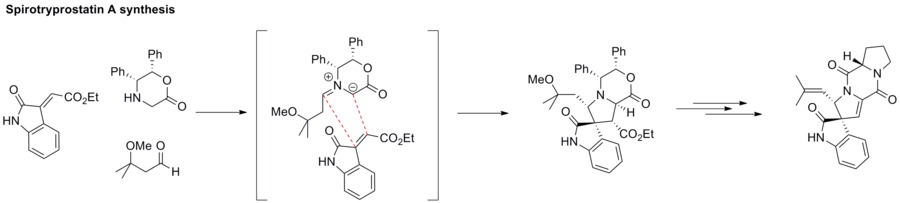
1,3-Dipolar cycloaddition between an azomethine ylide and an alkene furnishes an azacyclic structure, such as pyrrolidine. This strategy has been applied to the synthesis of spirotryprostatin A.[62]

Application of azomethine ylide in the synthesis of spirotryprostatin.tif

Ozone

Ozonolysis is a very important organic reaction. Alkenes and alkynes can be cleaved by ozonolysis to give aldehyde, ketone or carboxylic acid products.

Biological Applications

The 1,3-dipolar cycloaddition between organic azides and terminal alkynes (i.e., the Huisgen cycloaddition) has been widely utilized for bioconjugation.

Copper catalysis

The Huisgen reaction generally does not proceed readily under mild conditions. Meldal et al. and Sharpless et al. independently developed a copper(I)-catalyzed version of the Huisgen reaction, CuAAC (for Copper-catalyzed Azide-Alkyne Cycloaddition), which proceeds very readily in mild, including physiological, conditions (neutral pH, room temperature and aqueous solution).[63][64] This reaction is also bioorthogonal: azides and alkynes are both generally absent from biological systems and therefore these functionalities can be chemoselectively reacted even in the cellular context. They also do not react with other functional groups found in Nature, so they do not perturb biological systems. The reaction is so versatile that it is termed the “Click” chemistry. Although copper(I) is toxic, many protective ligands have been developed to both reduce cytotoxicity and improve rate of CuAAC, allowing it to be used in in vivo studies.[65]

Copper catalyzed AAC.tif

For example, Bertozzi et al. reported the metabolic incorporation of azide-functionalized sugars into the glycan of the cell membrane, and subsequent labeling with fluorophore-alkyne conjugate. The now fluorescently labeled cell membrane can be imaged under the microscope.[66]

Metabolic labeling with GlcNAz and click chemistry.tif

Strain-promoted cycloaddition

To avoid toxicity of copper(I), Bertozzi et al. developed the Strain-Promoted Azide-Alkyne Cycloaddition (SPAAC) between organic azide and strained cyclooctyne. The angle distortion of the cyclooctyne helps to speed up the reaction, enabling it to be used in physiological conditions without the need for the catalyst.[67]

Strained promoted AAC.tif

For instance, Ting et al. introduced an azido functionality onto specific proteins on the cell surface using a ligase enzyme. The azide-tagged protein is then labeled with cyclooctyne-fluorophore conjugate to yield a fluorescently labeled protein.[68]

Enzyme-mediated labeling with azidooctanoic acid and SPAAC.tif
CLIP

Computational Studies of 1,3-Dipolar [3 + 2]-Cycloaddition Reactions of Fullerene-C60 with Nitrones

Richard Tia*, Jacob Amevor and Evans Adei

Department of Chemistry, Kwame Nkrumah University of Science and Technology, Kumasi, Ghana

*Corresponding Author:
Richard Tia
Department of Chemistry
Kwame Nkrumah University of Science and Technology
Kumasi, Ghana
Tel: 00233(0) 243574146
E-mail: [email protected]

Received date: May 12, 2014; Accepted date: Septem

Image result for [3 + 2] Dipolar Cycloadditions

References

  1. Jump up^ Huisgen, Rolf (1963). “1.3-Dipolare Cycloadditionen Ruckschau und Ausblick.” (abstract). Angewandte Chemie. 75: 604–637. doi:10.1002/ange.19630751304.
  2. ^ Jump up to:a b Huisgen, Rolf (November 1963). “Kinetics and Mechanism of 1,3-Dipolar Cycloadditions”. Angewandte Chemie International Edition. 2 (11): 633–645. doi:10.1002/anie.196306331.
  3. Jump up^ Fireston, R (1968). “Mechanism of 1,3-dipolar cycloadditions”. Journal of Organic Chemistry. 33: 2285–2290. doi:10.1021/jo01270a023.
  4. Jump up^ Huisgen, Rolf (1976). “1,3-Dipolar cycloadditions. 76. Concerted nature of 1,3-dipolar cycloadditions and the question of diradical intermediates”. Journal of Organic Chemistry. 41: 403–419. doi:10.1021/jo00865a001.
  5. Jump up^ Mloston, G.; Langhals, E.; Huisgen, Rolf (1986). “First Two-Step 1,2-Dipolar Cycloadditons: Nonstereospecificity”. J. Am. Chem. Soc. 108: 6401–66402. doi:10.1021/ja00280a053.
  6. Jump up^ Seyyed Amir, Siadati (2015). “An example of a stepwise mechanism for the catalyst-free 1,3-dipolar cycloaddition between a nitrile oxide and an electron rich alkene”. Tetrahedron Letters. 56: 4857–4863. doi:10.1016/j.tetlet.2015.06.048.
  7. Jump up^ Huisgen, Rolf (1963). “1,3-Dipolar Cycloadditions. Past and Future”. Angewandte Chemie International Edition. 2: 565–598. doi:10.1002/anie.196305651.
  8. Jump up^ Cox, A; Thomas, L; Sheridan, J (1958). “Microwave Spectra of Diazomethane and its Deutero Derivatives”. Nature. 181 (4614): 1000–1001. doi:10.1038/1811000a0.
  9. Jump up^ Hilberty, P; Leforestier, C (1978). “Expansion of molecular orbital wave functions into valence bond wave functions. A simplified procedure.”. Journal of the American Chemical Society. 100: 2012–2017. doi:10.1021/ja00475a007.
  10. Jump up^ McGarrity, J.F.; Patai, Saul (1978). “Basicity, acidity and hydrogen bonding”. Diazonium and Diazo Groups. 1: 179–230. doi:10.1002/9780470771549.ch6.
  11. Jump up^ Berner, Daniel; McGarrity, John (1979). “Direct observation of the methyldiazonium ion in fluorosulfuric acid”. Journal of the American Chemical Society. 101: 3135–3136. doi:10.1021/ja00505a059.
  12. Jump up^ Muller, Eugen; Rundel, Wolfgans (1956). “Untersuchungen an Diazomethanen, VI. Mitteil.: Umsetzung von Diazoäthan mit Methyllithium”. Chemische Berichte. 89: 1065–1071. doi:10.1002/cber.19560890436.
  13. Jump up^ Geittner, Jochen; Huisgen, Rolph; Reissig, Hans-Ulrich (1978). “Solvent Dependence of Cycloaddition Rates of Phenyldiazomethane and Activation Parameters”. Heterocycles. 11: 109–120. doi:10.3987/S(N)-1978-01-0109.
  14. Jump up^ Huisgen, Rolph; Reissig, Hans-Ulrich; Huber, Helmut; Voss, Sabine (1979). “α-Diazocarbonyl compounds and enamines – a dichotomy of reaction paths”. Tetrahedron Letters. 20: 2987–2990. doi:10.1016/S0040-4039(00)70991-9.
  15. Jump up^ Sustmann, R (1974). “Orbital energy control of cycloaddition reactivity”. Pure and Applied Chemistry. 40: 569–593. doi:10.1351/pac197440040569.
  16. Jump up^ Geittner, Jochen; Huisgen, Rolf (1977). “Kinetics of 1,3-dipolar cycloaddition reactions of diazomethane; A correlation with homo-lumo energies”. Tetrahedron Letters. 18: 881–884. doi:10.1016/S0040-4039(01)92781-9.
  17. Jump up^ Huisgen, Rolf; Szeimies, Gunter; Mobius, Leander (1967). “K1.3-Dipolare Cycloadditionen, XXXII. Kinetik der Additionen organischer Azide an CC-Mehrfachbindungen”. Chemische Berichte. 100: 2494–2507. doi:10.1002/cber.19671000806.
  18. Jump up^ Williamson, D. G.; Cvetanovic, R. J. (1968). “Rates of ozone-olefin reactions in carbon tetrachloride solutions”. Journal of the American Chemical Society. 90: 3668–3672. doi:10.1021/ja01016a011.
  19. Jump up^ Bihlmaier, Werner; Geittner, Jochen; Huisgen, Rolf; ReissigP, Hans-Ulrich (1978). “The Stereospecificity of Diazomethane Cycloadditions”. Heterocycles. 10: 147–152. doi:10.3987/S-1978-01-0147.
  20. Jump up^ Huisgen, Rolf; Scheer, Wolfgang; Huber, Helmut (1967). “Stereospecific Conversion of cis-trans Isomeric Aziridines to Open-Chain Azomethine Ylides”. Journal of the American Chemical Society. 89: 1753–1755. doi:10.1021/ja00983a052.
  21. Jump up^ Dahmen, Alexander; Hamberger, Helmut; Huisgen, Rolf; Markowski, Volker (1971). “Conrotatory ring opening of cyanostilbene oxides to carbonyl ylides”. Journal of the Chemical Society D: Chemical Communications: 1192–1194. doi:10.1039/C29710001192.
  22. Jump up^ Padwa, Albert; Smolanoff, Joel (1971). “Photocycloaddition of arylazirenes with electron-deficient olefins”. Journal of the American Chemical Society. 93: 548–550. doi:10.1021/ja00731a056.
  23. Jump up^ Iwashita, Takashi; Kusumi, Takenori; Kakisawa, Hiroshi (1979). “A Synthesis of dl-isoretronecanol”. Chemistry Letters: 1337–1340. doi:10.1246/cl.1979.1337.
  24. Jump up^ Wang, Chia-Lin; Ripka, William; Confalone, Pat (1984). “A short and stereospecific synthesis of (±)-α-lycorane”. Tetrahedron Letters. 25: 4613–4616. doi:10.1016/S0040-4039(01)91213-4.
  25. Jump up^ Kanemasa, Shuji (2002). “Metal-Assisted Stereocontrol of 1,3-Dipolar Cycloaddition Reactions”. Synthesis Letters. 2002: 1371–1387. doi:10.1055/s-2002-33506.
  26. Jump up^ Bode, Jeffrey; Carreira, Erick (2011). “Stereoselective Syntheses of Epothilones A and B via Directed Nitrile Oxide Cycloaddition.”. Journal of the American Chemical Society. 123 (15): 3611–3612. doi:10.1021/ja0155635. PMID 11472140.
  27. Jump up^ Vsevolod V. Rostovtsev; Luke G. Green; Valery V. Fokin; K. Barry Sharpless (2002). “A Stepwise Huisgen Cycloaddition Process: Copper(I)-Catalyzed Regioselective Ligation of Azides and Terminal Alkynes”. Angewandte Chemie International Edition. 41 (14): 2596–22599. doi:10.1002/1521-3773(20020715)41:14<2596::AID-ANIE2596>3.0.CO;2-4. PMID 12203546.
  28. Jump up^ Caramella, Pierluigi; Houk, K.N. (1976). “Geometries of nitrilium betaines. The clarification of apparently anomalous reactions of 1,3-dipoles”. Journal of the American Chemical Society. 98: 6397–6399. doi:10.1021/ja00436a062.
  29. Jump up^ Caramella, Pierluigi; Gandour, Ruth W.; Hall, Janet A.; Deville, Cynthia G.; Houk, K. N. (1977). “A derivation of the shapes and energies of the molecular orbitals of 1,3-dipoles. Geometry optimizations of these species by MINDO/2 and MINDO/3”. Journal of the American Chemical Society. 99: 385–392. doi:10.1021/ja00444a013.
  30. Jump up^ Huisgen, Rolf (November 1963). “Kinetics and Mechanism of 1,3-Dipolar Cycloadditions” (abstract). Angewandte Chemie International Edition. 2 (11): 633–645. doi:10.1002/anie.196306331.
  31. Jump up^ Padwa, Albert (1983). 1,3-Dipolar Cycloaddition Chemistry. General Heterocyclic Chemistry Series. 1. United States of America: Wiley-Interscience. pp. 141–145. ISBN 0-471-08364-X.
  32. Jump up^ Koszinowski, J. (1980). thesis (Ph.D. Thesis).
  33. Jump up^ Evans, David; Ripin, David; Halstead, David; Campos, Kevin (1999). “Synthesis and Absolute Stereochemical Assignment of (+)-Miyakolide”. Journal of the American Chemical Society. 121: 6816–6826. doi:10.1021/ja990789h.
  34. Jump up^ Synthetic Reactions of M=C and M=N Bonds: Ylide Formation, Rearrangement, and 1,3-Dipolar Cycloaddition; Hiyama, T. W., J., Ed.; Elsevier, 2007; Vol. 11.
  35. Jump up^ Padwa, A.; Hornbuckle, S. F. Ylide Formation from the Reaction of Carbenes and Carbenoids with Heteroatom Lone Pairs Chem Rev 1991, 91, 263.
  36. ^ Jump up to:a b Janulis, E. P.; Arduengo, A. J. Structure of an Electronically Stabilized Carbonyl Ylide J Am Chem Soc 1983, 105, 5929.
  37. Jump up^ Prakash, G. K. S.; Ellis, R. W.; Felberg, J. D.; Olah, G. A. Formaldehyde 0-Methylide, [CH2=O+-CH2: The Parent Carbonyl Ylide] J Am Chem Soc 1986, 108, 1341.
  38. Jump up^ Sammes, P. G.; Street, L. J. Intra molecular Cyclo additions with Oxido pyrylium Ylides J. Chem. Soc., Chem. Commun. 1982, 1056.
  39. Jump up^ Garst, M. E.; McBride, B. J.; Douglass III, J. G. Intramolecular cycloadditions with 2-(ω-alkenyl)-5-hydroxy-4-pyrones Tetrahedron Lett. 1983, 24, 1675.
  40. Jump up^ Gisch, J. F.; Landgrebe, J. A. Dichlorocarbene from flash vacuum pyrolysis of trimethyl(trichloromethyl)silane. Possible observation of 1,1-dichloro-3-phenylcarbonyl ylide J Org Chem 1985, 50, 2050.
  41. Jump up^ Huan, Z. W.; Landgrebe, J. A.; Peterson, K. Dibromocarbonyl ylides: Deoxygenation of aldehydes and ketones by dibromocarbene J Org Chem 1983, 48, 4519.
  42. Jump up^ Martin, C. W.; Lund, P. R.; Rapp, E.; Landgrebe, J. A. Halogenated carbonyl ylides in the reactions of mercurial dihalocarbene precursors with substituted benzaldehydes J Org Chem 1978, 43, 1071.
  43. Jump up^ Hodgson, D. M.; Bruckl, T.; Glen, R.; Labande, A. H.; Selden, D. A.; Dossetter, A. G.; Redgrave, A. J. Catalytic enantioselective intermolecular cycloadditions of 2-diazo-3,6-diketoester-derived carbonyl ylides with alkene dipolarophiles Proceedings of the National Academy of Sciences of the United States of America 2004, 101, 5450.
  44. Jump up^ Padwa, A.; Hertzog, D. L.; Nadler, W. R. Intramolecular Cycloaddition of Isomunchnone Dipoles to Heteroaromatic π-Systems J Org Chem 1994, 59, 7072.
  45. Jump up^ Hamaguchi, M.; Ibata, T. New Type of Mesoionic System. 1,3-Dipolar Cycloaddition of Isomunchnon With Ethylenic Compounds Chem Lett 1975, 499.
  46. Jump up^ Park, S. B.; Sakata, N.; Nishiyama, H. Aryloxycarbonylcarbene Complexes of Bis(oxazolinyl)pyridineruthenium as Active Intermediates in Asymmetric Catalytic Cyclopropanations Chem-Eur J 1996, 2, 303.
  47. Jump up^ Snyder, J. P.; Padwa, A.; Stengel, T.; Arduengo, A. J., 3rd; Jockisch, A.; Kim, H. J. A Stable Dirhodium Tetracarboxylate Carbenoid: Crystal Structure, Bonding Analysis, and Catalysis J Am Chem Soc 2001, 123, 11318.
  48. ^ Jump up to:a b Hodgson, D. M.; Pierard, F. Y. T. M.; Stupple, P. A. Catalytic enantioselective rearrangements and cycloadditions involving ylides from diazo compounds Chem Soc Rev 2001, 30, 50.
  49. Jump up^ Yoshikai, N.; Nakamura, E. Theoretical Studies on Diastereo- and Enantioselective Rhodium-Catalyzed Cyclization of Diazo Compound via Intramolecular C[BOND]H Bond Insertion Adv Synth Catal 2003, 345, 1159.
  50. Jump up^ Nakamura, E.; Yoshikai, N.; Yamanaka, M. Mechanism of C−H Bond Activation/C−C Bond Formation Reaction between Diazo Compound and Alkane Catalyzed by Dirhodium Tetracarboxylate J Am Chem Soc 2002, 124, 7181.
  51. Jump up^ Costantino, G.; Rovito, R.; Macchiarulo, A.; Pellicciari, R. Structure of metal–carbenoid intermediates derived from the dirhodium(II)tetracarboxylate mediated decomposition of α-diazocarbonyl compounds: a DFT study J Mol Struc-Theochem 2002, 581, 111.
  52. ^ Jump up to:a b c d M. Hodgson, D.; H. Labande, A.; Muthusamy, S. In Organic Reactions; John Wiley & Sons, Inc.: 2004.
  53. Jump up^ Suga, H.; Ebiura, Y.; Fukushima, K.; Kakehi, A.; Baba, T. Efficient Catalytic Effects of Lewis Acids in the 1,3-Dipolar Cycloaddition Reactions of Carbonyl Ylides with Imines J Org Chem 2005, 70, 10782.
  54. ^ Jump up to:a b Padwa, A.; Fryxell, G. E.; Zhi, L. Tandem cyclization-cycloaddition reaction of rhodium carbenoids. Scope and mechanistic details of the process J Am Chem Soc 1990, 112, 3100.
  55. Jump up^ Houk, K. N.; Sims, J.; Duke, R. E.; Strozier, R. W.; George, J. K. Frontier molecular orbitals of 1,3 dipoles and dipolarophiles J Am Chem Soc 1973, 95, 7287.
  56. Jump up^ Houk, K. N.; Rondan, N. G.; Santiago, C.; Gallo, C. J.; Gandour, R. W.; Griffin, G. W. Theoretical studies of the structures and reactions of substituted carbonyl ylides J Am Chem Soc 1980, 102, 1504.
  57. Jump up^ Padwa, A.; Weingarten, M. D. Cascade Processes of Metallo Carbenoids Chem Rev 1996, 96, 223.
  58. Jump up^ Padwa, A.; Austin, D. J.; Hornbuckle, Ligand-Induced Selectivity in the Rhodium(II)-Catalyzed Reactions of α-Diazo Carbonyl Compounds S. F. J Org Chem 1996, 61, 63.
  59. Jump up^ Suga, H.; Kakehi, A.; Ito, S.; Inoue, K.; Ishida, H.; Ibata, T. Stereocontrol in a Ytterbium Triflate-Catalyzed 1,3-Dipolar Cycloaddition Reaction of Carbonyl Ylide with N-Substituted Maleimides and Dimethyl Fumarate B Chem Soc Jpn 2001, 74, 1115.
  60. Jump up^ Geng, Z.; Chen, B.; Chiu, P. Total Synthesis of Pseudolaric Acid A Angewandte Chemie 2006, 45, 6197.
  61. Jump up^ Suga, H.; Inoue, K.; Inoue, S.; Kakehi, A.; Shiro, M. Chiral 2,6-Bis(oxazolinyl)pyridine−Rare Earth Metal Complexes as Catalysts for Highly Enantioselective 1,3-Dipolar Cycloaddition Reactions of 2-Benzopyrylium-4-olates J Org Chem 2005, 70, 47.
  62. Jump up^ Onishi, Tomoyuki; Sebahar, Paul; Williams, Robert (2003). “Concise, Asymmetric Total Synthesis of Spirotryprostatin A”. Organic Letters. 5: 3135–3137. doi:10.1021/ol0351910. PMID 12917000.
  63. Jump up^ Tornoe, Christian; Christensen, Caspar; Meldal, Morten (2002). “Peptidotriazoles on Solid Phase: [1,2,3]-Triazoles by Regiospecific Copper(I)-Catalyzed 1,3-Dipolar Cycloadditions of Terminal Alkynes to Azides”. Journal of Organic Chemistry. 67 (9): 3057–3064. doi:10.1021/jo011148j. PMID 11975567.
  64. Jump up^ Rostovtsev, Vsevolod; Green, Luke; Fokin, Valery; Sharpless, Barry K. (2002). “A Stepwise Huisgen Cycloaddition Process: Copper(I)-Catalyzed Regioselective Ligation of Azides and Terminal Alkynes”. Angewandte Chemie International Edition. 41: 2596–2599. doi:10.1002/1521-3773(20020715)41:14<2596::AID-ANIE2596>3.0.CO;2-4. PMID 12203546.
  65. Jump up^ Besanceney-Webler, Christen; Jiang, Hao; Zheng, Tianqing; Feng, Lei; Soriano del Amo, David; Wang, Wei; Klivansky, Liana M.; Marlow, Florence L.; Liu, Yi; Wu, Peng (2011). “Increasing the Efficacy of Bioorthogonal Click Reactions for Bioconjugation: A Comparative Study”. Angewandte Chemie International Edition. 50: 8051–8056. doi:10.1002/anie.201101817. PMC 3465470Freely accessible. PMID 21761519.
  66. Jump up^ Breidenbach, Mark; Gallagher, Jennifer; King, David; Smart, Brian; Wu, Peng; Bertozzi, Carolyn (2010). “Targeted metabolic labeling of yeast N-glycans with unnatural sugars”. Proceedings of the National Academy of Sciences of the United States of America. 107 (9): 3988–3993. doi:10.1073/pnas.0911247107. PMC 2840165Freely accessible. PMID 20142501.
  67. Jump up^ Agard, Nicholas; Prescher, Jennifer; Bertozzi, Carolyn (2004). “A Strain-Promoted [3 + 2] Azide−Alkyne Cycloaddition for Covalent Modification of Biomolecules in Living Systems”. Journal of the American Chemical Society. 46: 15046–15047. doi:10.1021/ja044996f. PMID 15547999.
  68. Jump up^ Fernandez-Suarez, Marta; Baruah, Hemanta; Martinez-Hernandez, Laura; Xie, Kathleen; Baskin, Jeremy; Bertozzi, Carolyn; Ting, Alice (2007). “Redirecting lipoic acid ligase for cell surface protein labeling with small-molecule probes”. Nature Biotechnology. 25: 1483–1487. doi:10.1038/nbt1355. PMC 2654346Freely accessible. PMID 18059260


///////////////[3 + 2] Dipolar Cycloadditions,  Flow Reactors

Share

Crystallization and relaxation dynamics of amorphous loratadine under different quench-cooling temperatures

 Uncategorized  Comments Off on Crystallization and relaxation dynamics of amorphous loratadine under different quench-cooling temperatures
Jan 082017
 

CrystEngComm, 2017, 19,335-345
DOI: 10.1039/C6CE01645F, Paper
Ruimiao Chang, Qiang Fu, Yong Li, Mingchan Wang, Wei Du, Chun Chang, Aiguo Zeng
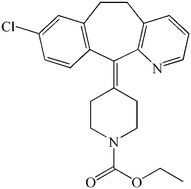
In this paper, four amorphous samples of loratadine were prepared by quench-cooling the melted drug at different temperatures.
In this paper, four amorphous samples of loratadine were prepared by quench-cooling the melted drug at different temperatures. With these samples, the crystallization tendencies were tested by powder X-ray diffraction (PXRD), and non-isothermal cold crystallization kinetics was investigated by using differential scanning calorimetry (DSC) and the molecular dynamics both in super-cooled liquid and in glassy states was analyzed by using broadband dielectric spectroscopy (BDS) at a temperature range from 213 to 393 K. From the PXRD results, it was established that the four amorphous loratadine samples were apt to crystallize at a temperature below the glass transition temperature. From the DSC results, it was found that the non-isothermal crystallization mechanism of these four loratadine forms was similar. However, the fast crystallization tendency (low physical stability) was also observed for the amorphous loratadine which was obtained at a low quench-cooling temperature. The tendency was analyzed based on the BDS results which demonstrated that rapid molecular mobility could generate a low physical stability and was closely related to Johari–Goldstein relaxation. These results suggested that loratadine had a weak frustration against crystallization and its physical stability was affected by the quench-cooling temperature. This study laid a foundation for choosing the right technique to prepare the amorphous form of loratadine and improving its physical stability.

Crystallization and relaxation dynamics of amorphous loratadine under different quench-cooling temperatures

Ruimiao Chang,ab   Qiang Fu,a   Yong Li,c  Mingchan Wang,a   Wei Du,a   Chun Changa and  Aiguo Zeng*a  
*Corresponding authors
aSchool of Pharmacy, Health Science Center, Xi’an Jiaotong University, Xi’an 710061, PR China
E-mail: [email protected]
Fax: +86 29 82655382
Tel: +86 29 82655136
bCollege of Pharmacy, Shanxi Medical University, Taiyuan, PR China
cDepartment of Pharmacy, Shanxi Dayi Hospital, Taiyuan 030032, PR China
CrystEngComm, 2017,19, 335-345

DOI: 10.1039/C6CE01645F

//////////
Share

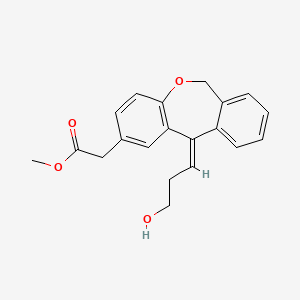
Methyl (Z)-11-[(3-Hydroxy)propylidene]-6,11-dihydrobenz[b,e]oxepin-2-acetate

 Uncategorized  Comments Off on Methyl (Z)-11-[(3-Hydroxy)propylidene]-6,11-dihydrobenz[b,e]oxepin-2-acetate
Jan 062017
 

Figure imgf000014_0002

E/Z

WO2014147647

White solid; Ή NMR (200 MHz, CDC13 + CC14): δ 2.38-2.49 ( m,0.8H, E- Form), 2.63-2.73 ( m,1.2H, Z-Form), 3.53 (s, 2H), 3.68 (s, 3H), 3.75 (m, 0.8H, E-Form), 3.81 (t, J=6.3 Hz, 1.2H), 5.19 (brs, 2H), 5.73 (t, J=7.8 Hz, 0.6H, Z-Form), 6.06 (t, J=7.8 Hz, 0.4H, E-Form), 6.70 (d, J=8.2 Hz, 0.4 H, E-Form), 6.79 (d, J=8.2 Hz, 0.6 H, Z- Form), 7.00-7.34 (m, 6H), HRMS m/r. Calculated for C20H2,O4-325.1434, observed- 325.1437.


CLIP 2

SCHEMBL18101051.png

Methyl (Z)-11-[(3-Hydroxy)propylidene]-6,11-dihydrobenz[b,e]oxepin-2-acetate 

916243-39-5  cas

mf C20 H20 O4
Dibenz[b,​e]​oxepin-​2-​acetic acid, 6,​11-​dihydro-​11-​(3-​hydroxypropylidene)​-​, methyl ester, (11Z)​-
Molecular Weight, 324.37
 white colorless crystal;
1H NMR (CDCl3, 300 MHz) δ 7.34–7.23 (m, 4H), 7.17 (d, J = 2.2 Hz, 1H), 7.04 (dd, J = 8.4, 2.2 Hz, 1H), 6.80 (d, J = 8.4 Hz, 1H), 5.74 (t, J = 7.5 Hz, 1H), 5.18 (brs, 2H), 3.80 (t, J = 6.1 Hz, 2H), 3.69 (s, 3H), 3.53 (s, 2H), 2.68 (dt, J = 7.5, 6.1 Hz, 2H);
13C NMR (CDCl3, 75 MHz): δ 172.4, 154.6, 145.3, 141.4, 133.6, 132.1, 130.0, 129.1, 127.5, 126.2, 125.7, 124.0, 119.7, 70.5, 62.6, 52.1, 40.1, 33.3;
MS ESI (+) m/z 325 [M + H]+.
Org. Process Res. Dev., 2012, 16 (2), pp 225–231
DOI: 10.1021/op200312m
CLIP 3
Synthesis 2013; 45(24): 3399-3403
DOI: 10.1055/s-0033-1340008
str1
CLICK ON IMAGE
1H AND 13C NMR PREDICT

“ALL FOR DRUGS” CATERS TO EDUCATION GLOBALLY, No commercial exploits are done or advertisements added by me. This article is a compilation for educational purposes only.

P.S. : The views expressed are my personal and in no-way suggest the views of the professional body or the company that I represent

//////O=C(OC)Cc1ccc2OCc3ccccc3C(=C\CCO)\c2c1

Share

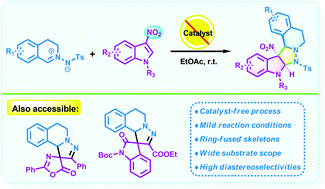
A catalyst-free 1,3-dipolar cycloaddition of C,N-cyclic azomethine imines and 3-nitroindoles: an easy access to five-ring-fused tetrahydroisoquinolines

 PROCESS, spectroscopy, SYNTHESIS  Comments Off on A catalyst-free 1,3-dipolar cycloaddition of C,N-cyclic azomethine imines and 3-nitroindoles: an easy access to five-ring-fused tetrahydroisoquinolines
Jan 062017
 

Graphical abstract: A catalyst-free 1,3-dipolar cycloaddition of C,N-cyclic azomethine imines and 3-nitroindoles: an easy access to five-ring-fused tetrahydroisoquinolines


We have reported herein a catalyst-free 1,3-dipolar cycloaddition of C,N-cyclic azomethine imines and 3-nitroindoles by which a series of five-ring-fused tetrahydroisoquinolines featuring an indoline scaffold were obtained as single diastereomers in moderate to high yields without any additives under mild conditions. Moreover, the current method provides a novel and convenient approach for the efficient incorporation of two biologically important scaffolds (tetrahydroisoquinoline and indoline).

http://pubs.rsc.org/en/Content/ArticleLanding/2017/GC/C6GC02517J?utm_medium=email&utm_campaign=pub-GC-vol-19-issue-1&utm_source=toc-alert#!divAbstract

A catalyst-free 1,3-dipolar cycloaddition of C,N-cyclic azomethine imines and 3-nitroindoles: an easy access to five-ring-fused tetrahydroisoquinolines

Xihong Liu,a   Dongxu Yang,a   Kezhou Wang,a  Jinlong Zhanga and   Rui Wang*ab  
*Corresponding authors
aSchool of Life Sciences, Institute of Biochemistry and Molecular Biology, Lanzhou University, Lanzhou 730000, P. R. China
E-mail: [email protected]
bState Key Laboratory of Chiroscience, Department of Applied Biology and Chemical Technology, The Hong Kong Polytechnic University, Kowloon, P. R. China
E-mail: [email protected]
Green Chem., 2017,19, 82-87

DOI: 10.1039/C6GC02517J


 ethyl 13b-nitro-8-tosyl-8,8a,13b,13c-tetrahydro-5H-indolo[2′,3′:3,4]pyrazolo[5,1- a]isoquinoline-9(6H)-carboxylate: White solid, m.p. 153 – 154 oC; 94% yield;
1H NMR (300 MHz, CDCl3) δ 7.86 (d, J = 8.2 Hz, 2H), 7.78 (d, J = 7.9 Hz, 1H), 7.30 – 7.13 (m, 5H), 7.1 (s, 1H), 7.05 – 6.94 (m, 1H), 6.94 – 6.87 (m, 1H), 6.59 (t, J = 7.6 Hz, 3H), 6.28 (d, J = 7.6 Hz, 1H), 4.78 (s, 1H), 4.37 (q, J = 7.1 Hz, 2H), 2.80 – 2.58 (m, 2H), 2.33 (s, 3H), 2.31 – 2.11 (m, 2H), 1.41 (t, J = 7.1 Hz, 3H) ppm;
13C NMR (75 MHz, CDCl3) δ 152.1, 144.6, 142.6, 134.0, 132.1, 129.3, 129.0, 128.7, 128.3, 127.5, 127.3, 126.2, 122.8, 121.1, 115.5, 104.5, 84.9, 70.7, 62.8, 48.5, 29.1, 21. 6, 14.3 ppm;
HRMS (ESI): C27H26N4NaO6S [M + Na]+ calcd: 557.1465, found: 557.1476.

“ALL FOR DRUGS” CATERS TO EDUCATION GLOBALLY, No commercial exploits are done or advertisements added by me. This article is a compilation for educational purposes only.

P.S. : The views expressed are my personal and in no-way suggest the views of the professional body or the company that I represent

/////////// catalyst-free,  1,3-dipolar cycloaddition, C,N-cyclic azomethine imines,  3-nitroindoles,  five-ring-fused tetrahydroisoquinolines
Share

Towards automation of chemical process route selection based on data mining

 PROCESS  Comments Off on Towards automation of chemical process route selection based on data mining
Jan 062017
 

Graphical abstract: Towards automation of chemical process route selection based on data mining

A methodology for chemical routes development and evaluation on the basis of data-mining is presented. A section of the Reaxys database was converted into a network, which was used to plan hypothetical synthesis routes to convert a bio-waste feedstock, limonene, to a bulk intermediate, benzoic acid. The route evaluation considered process conditions and used multiple indicators, including exergy, E-factor, solvent score, reaction reliability and route redox efficiency, in a multi-criteria environmental sustainability evaluation. The proposed methodology is the first route evaluation based on data mining, explicitly using reaction conditions, and is amenable to full automation.


In the field of process and synthetic chemistry ‘clean synthesis’ has become one of the standard criteria for good, commercially viable synthesis routes. As a result synthetic and process chemists must be equipped with adequate methodologies for quantification of ‘cleanness’ or ‘greenness’ of alternative routes at the early phases of the development cycle. These new criteria, and the traditional criteria of cost, security of supply, health and safety (H&S), and risk, provide a balanced picture of sustainability of a future technology. Thus, there are two separate aspects to process chemistry: developing the chemistry and the process, and evaluating the overall process, which must occur in parallel. Evaluation of the proposed routes requires data. As data science rapidly evolves, chemistry will inevitably use more of the new tools of data mining and data analysis to automate the routine tasks, such as evaluation of process metrics. In this paper we show some initial results in automation of process evaluation based on deep data mining of process chemistry and multi-criteria decision making.

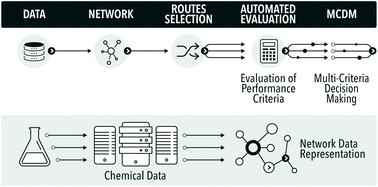
The evaluation of greenness is a mature field, with a large number of published and standardised approaches, of which many are adopted by industry. 1 However, all published methods are highly case-specific and rather labour-intensive. In the field of synthetic routes development one of the most exciting new areas is the potential for automation of synthesis planning using data mining.2 What has never been attempted before is to automate route generation and evaluation in a coherent methodology, which would aid process development at the early, data-lean, stages. For this we show how to automatically generate process options using a network representation of a section of Reaxys database,3 followed by their screening using multi-criteria decision making, see Fig. 1. As the methods mature and become commercially available, such integration and automation will produce significant savings of time, and would deliver a far more detailed view of the competing synthesis route options than is generally possible at the early stages of design.

To date, obtaining the data, assembling the network and finding potential synthesis routes can already be carried out in a fully automated fashion. Due to issues around data availability the connection to the analysis of the routes still has to be initiated manually, involving a data curation step. The subsequent analysis and multi-criteria decision making have been largely automated in this study. To our knowledge this is the first example of the analysis of synthesis routes generated from the network representation of Reaxys obtained through datamining, using reaction conditions and process data.

image file: c6gc02482c-f2.tif

Fig. 2 A section of a network of organic chemistry. Dots are species and arrows represent reactions.
  1. D. J. C. Constable, C. Jimenez-Gonzalez and A. Lapkin, in Green Chemistry Metrics, John Wiley & Sons, Ltd, Chichester, UK, 2009, pp. 228–247 
  2. S. Szymkuć, E. P. Gajewska, T. Klucznik, K. Molga, P. Dittwald, M. Startek, M. Bajczyk and B. A. Grzybowski, Angew. Chem., Int. Ed., 2016, 55, 5904–5937 
  3. Reed Elsevier Properties SA, Login – Reaxys Login Page [Internet], 2014 [accessed 2014 Jun 8]. Available from: https://www.reaxys.com/. Reaxys is a trademark, copyright owned by Relex Intellectual properties SA and used under licence.

Towards automation of chemical process route selection based on data mining

*Corresponding authors
aDepartment of Chemical Engineering and Biotechnology, University of Cambridge, Cambridge CB2 3RA, UK
E-mail: [email protected]
Green Chem., 2017,19, 140-152

DOI: 10.1039/C6GC02482C, http://pubs.rsc.org/en/Content/ArticleLanding/2017/GC/C6GC02482C?utm_medium=email&utm_campaign=pub-GC-vol-19-issue-1&utm_source=toc-alert#!divAbstract

Professor Alexei Lapkin, FRSC

Professor Alexei Lapkin FRSC

Professor of Sustainable Reaction Engineering

Fellow of Wolfson College

Catalytic Reaction Engineering

Sustainable Chemical Technologies

Office Phone: 330141

University of Cambridge
Image result for Department of Chemical Engineering and Biotechnology, University of Cambridge, Cambridge CB2 3RA, UK

Biography:

MChem in Biochemistry, Novosibirsk State University, 1994

PhD in Chemical Engineering, University of Bath, 2000

Boreskov Institute of Catalysis, Novosibirsk, Russia (1994-1997)

University of Bath, Department of Chemical Engineering, Research Officer (1997-2000)

University of Bath, Department of Chemical Engineering, Lecturer-SL-Reader (2000-2009)

University of Warwick, School of Engineering, Professor of Engineering (2009-2013)

Research Interests

Reaction Engineering group

Our group is developing cleaner manufacturing processes within chemical and chemistry using industries. We are mainly focusing on liquid- and multi-phase catalytic and biochemical processes. Within the group we have pursued projects on developing functional materials for catalysts, adsorbents and reactors, design of multi-functional intensive reactors, modelling of reaction kinetics and integrated processes, linking reaction kinetics with computational fluid dynamics (CFD) and linking process modelling with life cycle assessment (LCA), integration of reactions and separation.

Public funding:

The group is currently involved in an EU project ‘RECOBA’ (http://www.spire2030.eu/recoba/), in which our group collaborates with Materials and Electronic Engineering at Cambridge to work on innovative measurement techniques for monitoring processes under reaction conditions.

We are involved in the EPSRC project on developing novel routes to platform and functional molecules from waste terpenes, led by University of Bath.

We are involved in “Dial a Molecule 2” network funded by EPSRC.

Keywords

  • Reaction Engineering
  • flow
  • sustainability
  • heterogeneous catalysis
  • catalysis

Key Publications

J. Zakrzhewski, A.P. Smalley, M. Kabeshov, A. Lapkin, M. Gaunt, Continuous flow synthesis and derivatization of aziridines via palladium-catalyzed C(sp3)-H activation, Angew. Chem. Int. Ed., 55 (2016) 8878-8883.

P. Yaseneva, P. Hodgson, J. Zakrzewski, S. Falss, R.E. Meadows, A.A. Lapkin, Continuous flow Buchwald-Hartwig amination of a pharmaceutical intermediate, React. Chem. Eng., 1 (2016) 229-238.

P. Yaseneva, D. Plaza, X. Fan, K. Loponov, A. Lapkin, Synthesis of the antimalarial API artemether in a flow reactor, Catal. Today, 239 (2015) 90-96.

N. Peremezhney, E. Hines, A. Lapkin, C. Connaughton, Combining Gaussian processes, mutual information and a generic algorithm for multi-targeted optimisation of expensive-to-evaluate functions, Engineering Optimisation, 46 (2014) 1593-1607.

P. Yaseneva, C.F. Marti, E. Palomares, X. Fan, T. Morgan,P.S. Perez, M. Ronning, F. Huang,T. Yuranova, L. Kiwi-Minsker, S. Derrouiche, A.A. Lapkin, Efficient reduction of bromates using carbon nanofibre supported catalysts: experimental and a comparative life cycle assessment study, Chem. Eng. J., 248 (2014) 230-241

K.N. Loponov, J. Lopes, M. Barlog, E.V. Astrova, A.V. Malkov, A.A. Lapkin, Optimization of a Scalable Photochemical Reactor for Reactions with Singlet Oxygen, Org.Process Res.Dev., 18 (2014) 1443-1454.

X. Fan, V. Sans, P. Yaseneva, D. Plaza, J.M.J. Williams, A.A. Lapkin, Facile Stoichiometric Reductions in Flow: an Example of Artemisinin, Org.Process Res.Dev., 16 (2012) 1039-1042.

M.V. Sotenko, M. Rebros, V.S. Sans, K.N. Loponov, M.G. Davidson, G. Stephens, A.A. Lapkin, Tandem transformation of glycerol to esters, J. Biotechnol., 162 (2012) 390-397.

A.A. Lapkin, A. Voutchkova, P. Anastas, A conceptual framework for description of complexity in intensive chemical processes, Chem. Eng. Processing. Process intensification, 50 (2011) 1027-1034.

Lapkin, A., Peters, M., Greiner, L., Chemat, S., Leonhard, K., Liauw, M. A. and Leitner, W., Screening of new solvents for artemisinin extraction process using ab-initio methodology, Green Chem., 12 (2010) 241-251.

Lapkin, A. A. and Plucinski, P. K., Engineering factors for efficient flow processes in chemical industries, in Chemical reactions and processes under flow conditions, pp. 1- 43, Eds: Luis, S. V. and Garcia-Verdugo, E., Royal Society of Chemistry, Cambridge, 2010.

Iwan, A., Stephenson, H., Ketchie, W. C. and Lapkin, A. A., High temperature sequestration of CO2 using lithium zirconates, Chem. Eng. J., 146 (2009) 249-258.

Constable, D. J. C., Jimenez-Gonzalez, C. and Lapkin A., ‘Process metrics’, in Green chemistry metrics: measuring and monitoring sustainable processes, pp.  228- 247, Eds.: Lapkin, A. and Constable, D. J. C., Wiley-Blackwell, Chichester, 2008.

L.Torrente-Murciano, A.Lapkin, D.V. Bavykin, F.C. Walsh, K. Wilson, Highly selective Pd/titanate nanotubes catalysts for the double bond migration reaction, J. Catal., 245 (2007) 270-276.

A. Lapkin, P. Plucinski, Comparative assessment of technologies for extraction of artemisinin, J. Natural Prod., 69 (2006) 1653-1664.

D.V. Bavykin, A.A. Lapkin, S.T. Kolaczkowski, P.K. Plucinski, Selective oxidation of alcohols in a continuous multifunctional reactor: ruthenium oxide catalysed oxidation of benzyl alcohol, Applied Catal. A: General, 288 (2005) 165-174.

Image result for A. A. Lapkin

////////automation, chemical process,  route selection, data mining

Share

Overcoming barriers to green chemistry in the pharmaceutical industry – the Green Aspiration Level™ concept

 SYNTHESIS, Uncategorized  Comments Off on Overcoming barriers to green chemistry in the pharmaceutical industry – the Green Aspiration Level™ concept
Jan 062017
 

Image result for Frank Roschangar


Image result for Frank Roschangar

Scheme 1. Pfizer’s Commercial Synthesis of sildenafil citrate (Viagra™)

Image result for Overcoming Barriers to Green Chemistry in the Pharmaceutical Industry - The Green Aspiration Level™ Concept


str1

Image result for Frank Roschangar

Image result for Frank Roschangar

“Green chemistry” refers to the promotion of safe, sustainable, and waste-minimizing chemical processes. The proliferation of green chemistry metrics without any clear consensus on industry standards is a significant barrier to the adoption of green chemistry within the pharmaceutical industry. We propose the Green Aspiration Level™ (GAL) concept as a novel process performance metric that quantifies the environmental impact of producing a specific pharmaceutical agent while taking into account the complexity of the ideal synthetic process for producing the target molecule. Application of the GAL metric will make possible for the first time an assessment of relative greenness of a process, in terms of waste, versus industry standards for the production process of any pharmaceutical. Our recommendations also include a simple methodology for defining process starting points, which is an important aspect of standardizing measurement to ensure that Relative Process Greenness (RPG) comparisons are meaningful. We demonstrate our methodology using Pfizer’s Viagra™ process as an example, and outline aspiration level opportunities for industry and government to dismantle green chemistry barriers.


Graphical abstract: Overcoming barriers to green chemistry in the pharmaceutical industry – the Green Aspiration Level™ concept


Overcoming barriers to green chemistry in the pharmaceutical industry – the Green Aspiration Level™ concept

*Corresponding authors
aChemical Development US, Boehringer Ingelheim Pharmaceuticals, Inc., Ridgefield, USA
E-mail: [email protected]
bDelft University of Technology, Julianalaan 136, 2628 BL Delft, The Netherlands
Green Chem., 2015,17, 752-768

DOI: 10.1039/C4GC01563K, http://pubs.rsc.org/en/content/articlelanding/2015/gc/c4gc01563k#!divAbstract

“ALL FOR DRUGS” CATERS TO EDUCATION GLOBALLY, No commercial exploits are done or advertisements added by me. This article is a compilation for educational purposes only.

P.S. : The views expressed are my personal and in no-way suggest the views of the professional body or the company that I represent

///////////green chemistry,  pharmaceutical industry

Share

A deeper shade of green: inspiring sustainable drug manufacturing

 drugs  Comments Off on A deeper shade of green: inspiring sustainable drug manufacturing
Jan 062017
 

Graphical abstract: A deeper shade of green: inspiring sustainable drug manufacturing

Green and sustainable drug manufacturing go hand in hand with forward-looking visions seeking to balance the long-term sustainability of business, society, and the environment. However, a lack of harmonization among available metrics has inhibited opportunities for green chemistry in industry. Moreover, inconsistent starting points for analysis and neglected complexities for diverse manufacturing processes have made developing objective goals a challenge. Herein we put forward a practical strategy to overcome these barriers using data from in-depth analysis of 46 drug manufacturing processes from nine large pharmaceutical firms, and propose the Green Aspiration Level as metric of choice to enable the critically needed consistency in smart green manufacturing goals. In addition, we quantify the importance of green chemistry in the often overlooked, yet enormously impactful, outsourced portion of the supply chain, and introduce the Green Scorecard as a value added sustainability communication tool.

http://pubs.rsc.org/en/Content/ArticleLanding/2017/GC/C6GC02901A?utm_medium=email&utm_campaign=pub-GC-vol-19-issue-1&utm_source=toc-alert#!divAbstract

The Green Aspiration Level (GAL) has been constructed on four pillars to ensure consistent application, namely (1) clearly defined synthesis starting points,1 (2) unambiguous complete E factor (cEF)2,3 or Process Mass Intensity (PMI) waste metrics, (3) historical averages of industrial drug manufacturing waste, and (4) complexity of the drug’s ideal manufacturing process (Supplementary Figure 6). cEF or PMI can be used interchangeably in GAL-based analysis enabling organizations using either to calculate their green performance scores. cEF and PMI differ by just one unit (Supplementary Equation 6) and share the same commercial waste goal for an average manufacturing step4 – the transformation-GAL or tGAL – that results in negligible numerical differences from the inclusion of one or the other. The pharmaceutical industry has generally adopted PMI. However, our publication utilizes cEF values due to literature prevalence and potentially broader appeal of E factors.5 It is important to note that all reaction and workup materials are included in the analysis, but excluded are reactor cleaning6 and solvent recycling.7 Standardized process starting points are a critical component of the GAL methodology. A starting material for some may be an intermediate for others. Until recently, the scientific community lacked an unambiguous definition of process starting points in the assessment of process greenness. This has been a bothersome source of inconsistency. Failure to define an appropriate starting material can lead to exclusion of significant amounts of intrinsic raw material waste created during earlier stages of manufacture. We therefore utilize these updated definitions of process analysis starting points to ensuring higher quality of data:8

1) The material is commercially available from a major reputable chemical laboratory catalog company, and its price is listed in the (online) catalog. Materials requiring bulk or custom quotes do not qualify as process starting material. AND 2) The laboratory catalog cost of the material at its largest offered quantity does not exceed US $100/mol. Therefore, published literature must be researched if the material does not qualify as process starting material in order to determine its correct intrinsic cEF. However, we realized that determination of literature cEF values is tedious and involves making assumptions since literature procedures are often incomplete compared to internal or external manufacturing batch records. Thus, standardizing Literature cEF quickly became a desirable goal. In order to facilitate literature analysis we introduced Supplementary Equation 7 that just requires determination of literature step count from ≤$100/mol starting materials without having to retrieve literature waste information.9 The literature step multiplier of 37 kg/kg represents the average literature step cEF across the analyzed projects (Supplementary Table 1), so it equals their average literature cEF (76 kg/kg) divided by average literature step count (2.1). The process cEF and Relative Process Greenness (RPG) derived from the simplified calculated cEF literature values are shown next to their progenitors in Supplementary Table 3. We observe that average calculated and manually determined cEF and RPG values are comparable and within 10% of their means across the three development phases. Thus, we consider the simplified method sound and an importtant element to achieving consistency in green process analysis.


str1 str2 str3 str4

A deeper shade of green: inspiring sustainable drug manufacturing

 *Corresponding authors
aChemical Development, Boehringer Ingelheim Pharmaceuticals, Ridgefield, USA
E-mail: [email protected]
bPharmaceutical Sciences – Worldwide Research & Development, Pfizer, Groton, USA
cPfizer, Sandwich, UK
dChemical & Analytical Development, Novartis Pharma, 4002 Basel, Switzerland
eAPI Chemistry, GlaxoSmithKline Medicines Research Centre, Stevenage, UK
fSmall Molecule Process Chemistry, Genentech, a Member of the Roche Group, South San Francisco, USA
gSmall Molecule Design and Development, Eli Lilly and Company, Indianapolis, USA
hChemical and Synthetic Development, Bristol-Myers Squibb, New Brunswick, USA
iProcess Chemistry, Merck, Rahway, New Jersey 07065, USA
jProcess Development, Amgen, Thousand Oaks, USA
kMolecular Sciences Institute, School of Chemistry, University of the Witwatersrand, Johannesburg, South Africa
lDelft University of Technology, 2628 BL Delft, Netherlands
Green Chem., 2017,19, 281-285

DOI: 10.1039/C6GC02901A

Frank Roschangar, PhD MBA

Frank Roschangar, PhD MBA

Pharmaceutical process research director, passionate about accelerating drug development and driving green chemistry.

Boehringer Ingelheim
Ingelheim am Rhein, Germany

Research experience

  • Feb 2002–Sep 2015
     Director
    Boehringer Ingelheim
    Germany · Nieder-Ingelheim
  • Aug 1996–Feb 1998
    Postdoc
    The Scripps Research Institute · Skaggs Institute for Chemical Biology · Prof. K.C. Nicolaou
    United States · La Jolla
  • Aug 1992–Aug 1996
    PhD Candidate
    Rice University · Department of Chemistry
    United States · Houston
Supplementary References
1. The $100 per mol laboratory catalog pricing requirement described in Supplementary Discussion 1 does not apply to reagents, catalysts, ligands, and solvents, since they are produced for widespread application and are not specific to the process being evaluated.
2. Since the original E factor has been applied inconsistently, the cEF metric was introduced for the purpose of GAL analysis. cEF accounts for all process reaction and process workup materials, including raw materials, intermediates, reagents, process aids, solvents, and water.
3. All E factors reported herein represent the cEF or sEF contributions of the overall manufacturing process or the sub-process (e.g. external cEF, literature cEF) to produce 1 kg of drug substance.
4. We define a step as a chemical operation involving one or more chemical transformations that form and/or break covalent or ionic bonds and lead to a stable and isolable intermediate, but not necessarily include its isolation. Examples: • Simultaneous removal of two or more protection groups involves multiple transformations, yet it is carried out in one chemical operation  counted as one step • Sequential transformations via a stable and isolable intermediate that are carried out in two operations but without intermediate workup  counted as two steps • Formation of covalent bonds or salts that occur during workup  not counted as an extra step • Separate operation of salt formation from an isolated intermediate  counted as one step • Isolation of a product, following work-up, as a solution that can be stored  counted as one step.
5. A SciFinder search for the terms ‘Process Mass Intensity’, and ‘E factor’ and ‘Environmental impact factor’ on Nov. 14, 2016 revealed that the PMI concept was present in 12, 8, 9, and 12 publications for the years 2013-2016, respectively, while the E factor concept was mentioned 39, 45, 57, and 46 times (76-86%), respectively.
6. The GAL considers only direct process materials, i.e. materials used in the chemical steps and their workups. It does not include solvents and aqueous detergents required for reactor and equipment cleaning between batches or steps, nor the frequency and duration of the equipment and facility specific cleaning operations. These parameters are considered for comprehensive environmental impact in Life Cycle Assessment (LCA) analysis.
7. In US pharmaceutical manufacturing, recycling accounts for 25% of waste handling, while energy recovery burning and treatment constitute 38% and 35%, based on 2012 data from ‘The Right-To-Know Network’ (RTKNET.ORG), Toxic Releases (TRI) Database: http://rtknet.org/db/tri.
8. The $100 per mol commodity pricing criterion was established in ref. 15 of the main article based on the author’s professional experience. The authors of this manuscript consider this figure appropriate and helpful for providing a consistent analysis.
9. If a detailed procedure is available for a particular literature step, its calculated waste can be used in place of the 37 kg/kg default value.
10. J. Li and M. D. Eastgate, Current Complexity: a Tool for Assessing the Complexity of Organic Molecules. Org. Biomol. Chem. 2015,13, 7164–7176.
11. D. P. Kjell, I. A. Watson, C. N. Wolfe and J. T. Spitler, Complexity-Based Metric for Process Mass Intensity in the Pharmaceutical Industry. Org. Process Res. Dev. 2013, 17, 169– 174.
12. R. P. Sheridan, et al., Modeling a Crowdsourcing Definition of Molecular Complexity. J. Chem. Inf. Model. 2014, 54, 1604–1616.
13. M. F. Faul, et al., Part 2: Designation and Justification of API Starting Materials: Current Practices across Member Companies of the IQ Consortium. Org. Process Res. Dev. 2014, 18, 594–600.
14. Besides offering simplicity, the GAL’s process complexity model was selected vs. the alternative structural complexity measures due to its inherent ideality-derived consideration for available synthetic methodology.
15. See main article ref. 16: it defines Construction Reactions (CR) as chemical transformations that form skeletal C-C or C-heteroatom bonds. Strategic Redox Reactions (SRR) are construction reactions that directly establish the correct functionality found in the final product, and include asymmetric reductions or oxidations. All other types of non-strategic reactions are considered as Concession Steps (CS), and include functional group interconversions, non-strategic redox reactions, and protecting group manipulations.
16. M. E. Kopach, et al., Process Development and Pilot-Plant Synthesis of (2-Chlorophenyl)[2-(phenylsulfonyl)pyridin-3- yl]methanone. Org. Process Res. Dev. 2010, 14, 1229–1238.
17. M. E. Kopach, M. M. Murray, T. M. Braden, M. E. Kobierski, O. L. Williams, Improved Synthesis of 1-(Azidomethyl)-3,5-bis- (trifluoromethyl)benzene: Development of Batch and Microflow Azide Processes. Org. Process Res. Dev. 2009, 13, 152–160. 18. RCI (Process B) = 1 − ( ) = 0.25. RCI (Process C) = 1 − ( ) = 0.38

//////////green chemistry, drugs

Share

4-(2-Hydroxyethyl)-1,3-dihydro-2H-indol-2-one

 Uncategorized  Comments Off on 4-(2-Hydroxyethyl)-1,3-dihydro-2H-indol-2-one
Jan 022017


str1

13C NMR (DMSO-d6, 100 MHz): δ = 35.2, 36.8, 61.5, 107.4, 122.5, 125.4, 127.8, 136.1, 143.8, 176.9;


1H NMR

str1

1H NMR (DMSO-d6, 400 MHz): δ = 2.64 (t, J = 6.8 Hz, 2H), 3.44 (s, 2H), 3.59 (q, J = 6.8 Hz, 2H), 4.62 (t, J = 5.2 Hz, 1H), 6.64 (d, J = 7.6 Hz, 1H), 6.78 (d, J = 7.6 Hz, 1H), 7.08 (t, J = 7.2 Hz, 1H), 10.30 (s, 1H);


4-(2-Hydroxyethyl)-1,3-dihydro-2H-indol-2-one (13)

…………..as a white solid with 99% purity by HPLC (retention time: 19.0 min).
1H NMR (DMSO-d6, 400 MHz): δ = 2.64 (t, J = 6.8 Hz, 2H), 3.44 (s, 2H), 3.59 (q, J = 6.8 Hz, 2H), 4.62 (t, J = 5.2 Hz, 1H), 6.64 (d, J = 7.6 Hz, 1H), 6.78 (d, J = 7.6 Hz, 1H), 7.08 (t, J = 7.2 Hz, 1H), 10.30 (s, 1H);
13C NMR (DMSO-d6, 100 MHz): δ = 35.2, 36.8, 61.5, 107.4, 122.5, 125.4, 127.8, 136.1, 143.8, 176.9;
ESI-MS (m/z) 178 [M + H]+. Anal. Calcd for C10H11NO2: C, 67.78; H, 6.26; N, 7.90. Found: C, 67.73; H, 6.20; N, 7.82.

Abstract Image


A new and efficient manufacturing technology is disclosed in the present work for the preparation of 4-(2-hydroxyethyl)-1,3-dihydro-2H-indol-2-one, which is a key intermediate for ropinirole hydrochloride. The whole process gives the target molecule in 71% overall yield with 99% purity. In the final step, a novel nitro reduction/ring-closing/debenzylation takes place in one pot. All the intermediates can be used directly for the next step without purification in this process.

Org. Process Res. Dev., 2013, 17 (4), pp 714–717
1H NMR PREDICT
DOI: 10.1021/op400024astr1 str2
13C NMR PREDICT
str1 str2
“ALL FOR DRUGS” CATERS TO EDUCATION GLOBALLY, No commercial exploits are done or advertisements added by me. This article is a compilation for educational purposes only.

P.S. : The views expressed are my personal and in no-way suggest the views of the professional body or the company that I represent

///////////


Share

Highly Selective Phosgene-Free Carbamoylation of Aniline by Dimethyl Carbonate under Continuous-Flow Conditions

 FLOW CHEMISTRY, flow synthesis  Comments Off on Highly Selective Phosgene-Free Carbamoylation of Aniline by Dimethyl Carbonate under Continuous-Flow Conditions
Jan 022017
 

Abstract Image

Over the last 20 years organic carbamates have found numerous applications in pesticides, fungicides, herbicides, dyes, pharmaceuticals, cosmetics, and as protecting groups and intermediates for polyurethane synthesis. Recently, in order to avoid phosgene-based synthesis of carbamates, many environmentally benign and alternative pathways have been investigated. However, few examples of carbamoylation of aniline in continuous-flow apparatus have been reported. In this work, we report a high-yielding, dimethyl carbonate (DMC)-mediated carbamoylation of aniline in a fixed-bed continuously fed reactor employing basic zinc carbonate as catalyst. Several variables of the system have been investigated (i.e. molar ratio of reagents , flow rate, and reaction temperature) to optimize the operating conditions of the system.

Figure

Figure

Highly Selective Phosgene-Free Carbamoylation of Aniline by Dimethyl Carbonate under Continuous-Flow Conditions

Department of Environmental Sciences, Informatics and Statistics, Ca’ Foscari University of Venice, Dorsoduro 2137, 30123 Venezia, Italia
Org. Process Res. Dev., 2013, 17 (4), pp 679–683
*Tel.: (+39) 041 234 8642. Fax: (+39) 041 234 8620. E-mail: [email protected].

PIETRO TUNDO

logo unive

Tundo300X292

Profile:

PIETRO R. TUNDO is Professor of Organic Chemistry at Ca’ Foscari University of Venice (Italy).
He was guest researcher and teacher at College Station (Texas,1979-1981), Potsdam (New York, 1989-90) and Syracuse (New York, 1991-92), Chapel Hill, (North Carolina, 1995).
He is Member of the Bureau of IUPAC.

P: Tundo is author of about 300 scientific publications, 40 patents and many books.
His scientific interests are in the field of organic synthesis in selective methylations with low environmental impact, continuous flow chemistry, chemical detoxification of contaminants, hydrodehalogenation under multiphase conditions, phase-transfer catalysis (gas-liquid phase-transfer catalysis, GL-PTC), synthesis of crown-ethers and functionalized cryptands, supramolecular chemistry, heteropolyacids, and finally safe alternatives to harmful chemicals.
He is the sole author of the book “Continuous flow methods in organic synthesis” E. Horwood Pub., Chichester, UK, 1991 (378 pp.), and editor of about 15 books.

P. Tundo was President of Organic and Biomolecular Chemistry Division of IUPAC (biennium 2007-2009) and holder of the Unesco Chair on Green Chemistry (UNTWIN N.o 731). He founded and was Chairman (2004-2016) of the Working Party on “Green and Sustainable Chemistry” of Euchems (European Association for Chemical and Molecular Sciences).

Founder of the IUPAC International Conferences Series on Green Chemistry, he was awarded by American Chemical Society on 1983 (Kendall Award, with Janos Fendler), and by Federchimica (Italian association of chemical industries) on 1997 (An Intelligent Future).

P. Tundo coordinated many institutional and industrial research projects (EU, NATO, Dow, ICI, Roquette) and was Director of the 10 editions of the annual Summer School on Green Chemistry (Venezia, Italy) sponsored by the EU, UNESCO and NATO.
He was guest researcher and teacher at College Station (Texas,1979-1981), Potsdam (New York, 1989-90) and Syracuse (New York, 1991-92), Chapel Hill, (North Carolina, 1995).

He is holder of the Unesco Chair on Green Chemistry (UNTWIN N.o 731) and author of about 260 scientific publications and 30 patents.

Scientific interests are in the field of organic synthesis in selective methylations with low environmental impact, continuous flow chemistry, chemical detoxification of contaminants, hydrodehalogenation under multiphase conditions, phase-transfer catalysis (gas-liquid phase-transfer catalysis, GL-PTC), synthesis of crown-ethers and functionalized cryptands, supramolecular chemistry and finally, heteropolyacids.

He is the sole author of the book “Continuous flow methods in organic synthesis” E. Horwood Pub., Chichester, UK, 1991 (378 pp.), and editor of about 15 books.

P. Tundo was President of Organic and Biomolecular Chemistry Division of IUPAC (biennium 2007-2009) and presently is Chairman of Working Party of “Green and Sustainable Chemistry” of Euchems (European Association for Chemical and Molecular Sciences).

Founder of the IUPAC International Conferences Series on Green Chemistry, he was awarded by American Chemical Society on 1983 (Kendall Award, with Janos Fendler), and by Federchimica (Italian association of chemical industries) on 1997 (An Intelligent Future).

P. Tundo co-ordinated many institutional and industrial research projects (EU, NATO, Dow, ICI, Roquette) and was Director of the 10 editions of the annual Summer School on Green Chemistry (Venezia), the latter sponsored by the EU, UNESCO and NATO.

Contact:

Professor of Organic Chemistry
Ca’ Foscari University of Venice
IUPAC Bureau Member
Tel. +39 041 2348642
Mob. +39 349 3486191
E-mail: [email protected]

Phone 041 234 8642 / Lab .: 041 234 8669
E-mail [email protected]
[email protected] – 6th IUPAC Conference on Green Chemistry
[email protected] – TUNDO Pietro
Fax 041 234 8620
Web www.unive.it/persone/tundop

////////Carbamoylation of Aniline, Dimethyl Carbonate, Continuous-Flow Conditions, flow synthesis

“ALL FOR DRUGS” CATERS TO EDUCATION GLOBALLY, No commercial exploits are done or advertisements added by me. This article is a compilation for educational purposes only.

P.S. : The views expressed are my personal and in no-way suggest the views of the professional body or the company that I represent

Share

GMP’s for Early Stage Development of new Drug substances and products

 Uncategorized  Comments Off on GMP’s for Early Stage Development of new Drug substances and products
Jan 022017
 

Image result for GMPs for Early Stage Development

GMP’s for Early Stage Development of New Drug substances and products


The question of how Good Manufacturing Practice (GMP) guidelines should be applied during early stages of development continues to be discussed across the industry and is now the subject of a new initiative by the International Consortium on Innovation and Quality in Pharmaceutical Development (IQ Consortium)—an association of pharmaceutical and biotechnology companies aiming to advance innovation and quality in the development of pharmaceuticals. They have assembled a multidisciplinary team (GMPs in Early Development Working Group) to explore and define common industry approaches and to come up with suggestions for a harmonized approach. Their initial thoughts and conclusions are summarized in Pharm. Technol. 2012, 36 (6), 5458.
Image result for International Consortium on Innovation and Quality in Pharmaceutical Development (IQ Consortium)
From an industry perspective, it is common to consider the “early” phase of development as covering phases 1 and 2a clinical studies. During this phase, there is a high rate of product attrition and a high probability for intentionally introducing change into synthetic processes, dosage forms, analytical methods, and specifications. The quality system implemented during this early phase should take into account that these changes and adjustments are intrinsic to the work being performed prior to the determination of the final process and validation of the analytical methods during later stages of development.
Image result for “early” phase of development as covering phases 1 and 2a clinical studies
FDA guidance is already available on GMP requirements for phase 1 materials. (See Org. Process. Res. Dev. 2008, 12, 817.) Because many aspects of phase 2a clinical studies are similar in their scope and expectations, the working group feels there is an opportunity to extend this guidance across all early phase studies. Because products and processes are less well understood in the early phases of development, activities should focus on accumulating the appropriate knowledge to adequately ensure patient safety. Focusing on this area should ensure that beneficial therapies reach the clinic in an optimum time scale with minimal safety concerns.
Image result for “early” phase of development as covering phases 1 and 2a clinical studies
A follow-up article ( Pharm. Technol. 2012, 36 (7), 76−84) describes the working group’s approach to the subject of Analytical Method Validation. Their assessment has uncovered the need to differentiate the terms “validation” and “qualification”. Method qualification is based on the type, intended purpose, and scientific understanding of the type of method in use. Although not used for GMP release of clinical materials, qualified methods are reliable experimental methods that may be used for characterization work such as reference standards and the scientific prediction of shelf life. For example, in early development it would be sufficient for methods used for in-process testing to be qualified, whereas those methods used for release testing and for stability determination would be more fully validated.
In early development, a major purpose of analytical methods is to determine the potency of APIs and drug products to ensure that the correct dose is delivered in the clinic. Methods should also indicate stability, identify impurities and degradants, and allow characterization of key attributes. In the later stages, when processes are locked and need to be transferred to worldwide manufacturing facilities, methods need to be cost-effective, operationally viable, and suitably robust such that the methods will perform consistently. irrespective of where they are executed.
The authors advocate that the same amount of rigorous and extensive method-validation experiments, as described in ICH Q2, “Analytical Validation”, is not needed for methods used to support early stage drug development. For example, parameters involving interlaboratory studies (i.e., intermediate precision, reproducibility, and robustness) are not typically performed during early phase development, being replaced by appropriate method-transfer assessments and verified by system suitability requirements. Because of changes in synthetic routes and formulations, the impurities and degradation products formed may change during development.
Accordingly, related substances are often determined using area percentage by assuming that the relative response factors are similar to that of the API. As a result, extensive studies to demonstrate mass balance are typically not conducted during early development.
Detailed recommendations are provided for each aspect of method validation (specificity, accuracy, precision, limit of detection, limit of quantitation, linearity, range, robustness) according to the nature of the test (identification, assay, impurity, physical tests) for both early- and late phase development. These recommendations are also neatly summarized in a matrix form.
Above text drew attention to a series of articles from the IQ Consortium (International Consortium on Innovation and Quality in Pharmaceutical Development) on appropriate good manufacturing practices (GMP) for the early development phases of new drug substances and products. The fifth article in this series(Coutant, M.; Ge, Z.; McElvain, J. S.; Miller, S. A.; O’Connor, D.; Swanek, F.; Szulc, M.; Trone, M. D.; Wong-Moon, K.; Yazdanian, M.; Yehl, P.; Zhang, S.Early Development GMPs for Small-Molecule Specifications: An Industry Perspective (Part V) Pharm. Technol. 2012, 36 ( 10) 8694) focuses on the setting of specifications during these early phases (I and IIa).
Due to the high attrition rate in early development, the focus should be on consistent specifications that ensure patient safety, supported by preclinical and early clinical safety studies. On the basis of the cumulative industry experience of the IQ working group members, the authors of this paper propose standardized early phase specification tests and acceptance criteria for both drug substance and drug product. In addition to release and stability tests, consideration is given to internal tests and acceptance criteria that are not normally part of formal specifications, but which may be performed to collect information for product and process understanding or to provide greater control.
Image result for preclinical animal studies
The drug substance used in preclinical animal studies (tox batch) is fundamental in defining the specifications for an early phase clinical drug substance (DS). Here, internal targets rather than formal specifications are routinely used while gathering knowledge about impurities and processing capabilities. At this stage the emphasis should be on ensuring the correct DS is administered, determining the correct potency value, and quantitating impurities for toxicology purposes. For DS intended for clinical studies, additional testing and controls may be required; the testing may be similar to that for the tox batch, but now with established acceptance criteria. For these stages the authors propose a standardized set of DS specifications, as follows.
Description range of colour
identification conforms to a reference spectrum
counterion report results
assay 97–103% on a dry basis
impurities NMT 3.0% total, NMT 1.0% each
unidentified NMT 0.3%
unqualified NMT 0.15%
mutagenic follow EMA guidelines (pending ICH M7 guidance)
inorganic follow EMA guidelines (pending ICH Q3D guidance)
residual solvents use ICH Q3C limits or other justified limits for solvents used in final synthetic step
water content report results
solid form report results
particle size report results
residue on ignition NMT 1.0%
These may be altered in line with any specific knowledge of the compound in question. For example, if the DS is a hydrate or is known to be hygroscopic or sensitive to water, a specified water content may be appropriate. Of particular note is the use of impurity thresholds which are 3 times higher than those defined in ICH Q3 guidelines. Q3 was never intended to apply to clinical drugs, and higher thresholds can be justified by the limited exposure that patients experience during these early stages. Mutagenic impurities are the exception here, since in this area the existing official guidance does cover clinical drugs.
The fourth article in the series(Acken, B.; Alasandro, M.; Colgan, S.; Curry, P.; Diana, F.; Li, Q. C.; Li, Z. J.; Mazzeo, T.; Rignall, A.; Tan, Z. J.; Timpano, R.Early Development GMPs for Stability (Part IV) Pharm. Technol. 2012, 36 ( 9) 6470) considers appropriate approaches to stability testing during early clinical phases. Appropriate stability data at suitable storage conditions are required to support filing the clinical trial application (CTA/IND/IMPD) and use of the clinical material through the end of the clinical study. Several factors from business, regulatory, and scientific perspectives need to be taken into account when designing early stability studies, such as the risk tolerance of the sponsoring organization, the inherent stability of the drug substance and prior product, process and stability knowledge, the regulatory environment in the countries where the clinical trial will be conducted, and the projected future use of the product.
Often non-GMP DS batches are manufactured first and placed on stability to support a variety of product development activities.In many cases these batches will be representative of subsequent GMP batches from a stability perspective and can be used to establish an initial retest period for the DS and support a clinical submission. In early development, it is common for the manufacturing process to be improved; therefore, as the DS process evolves, an evaluation is needed to determine whether the initial batch placed on stability is still representative of the improved process. The authors advocate a science- and risk-based approach for deciding whether stability studies on new process batches are warranted.
The first step is to determine which DS attributes have an effect on stability. This step can be completed through paper-based risk assessments, prior knowledge, or through a head-to-head short-term stability challenge. If the revised process impacts one or more of these stability-related quality attributes, the new batch should be placed on stability—otherwise not. Typical changes encountered at this stage include changes in synthetic pathway, batch scale, manufacturing equipment or site, reagents, source materials, solvents used, and crystallization steps.
Image result for DS stability
In most cases, these changes will not result in changes in DS stability. Changes to the impurity profile are unlikely to affect stability, since most organically related impurities will be inert. On the other hand, catalytic metals, acidic or basic inorganic impurities, or significant amounts of residual water or solvents may affect stability; thus, changes to these attributes would typically require the new batch to be placed in the stability program. Similarly, any changes to polymorphic form, particle size, or counterion would warrant extra testing. Packaging changes of the bulk material to a less protective package may require stability data to support the change.
Three approaches to stability data collection are commonly used. One is that an early, representative DS batch is placed under real-time and accelerated conditions (e.g., 25 °C/60% RH and 40 °C/75% RH), and stability results for a few time points (e.g., 1–6 months) are generated to support an initial retest period (e.g., 12 months or more). A second approach is to use high stress conditions such as a high temperature and high humidity with a short time. A third approach is the use of stress studies at several conditions coupled with modelling. The retest period derived from these types of accelerated or stress studies can be later verified by placing the first clinical batch into real-time stability studies under ICH accelerated and long-term conditions. Future extensions of the retest/use period can be based on real-time data.

“ALL FOR DRUGS” CATERS TO EDUCATION GLOBALLY, No commercial exploits are done or advertisements added by me. This article is a compilation for educational purposes only.

P.S. : The views expressed are my personal and in no-way suggest the views of the professional body or the company that I represent

////////
Share
Follow

Get every new post on this blog delivered to your Inbox.

Join other followers: